Haiku of a Homeschooler
---------------------
Pines in cool pale light
Mom and Dad and small ones doze
Sunday afternoon
----------------------
Red book edged in gold
Make my heart like unto Thine,
O most Sacred Heart.
----------------------
A crystal-eyed child,
Stuffed bears in war formation,
Boys are not like girls.
-------------------
Black tripartite form,
His thin limbs waving fiercely
Defending his queen.
---------------------
Bright dark eyes open
On bleached hospital pillow
My child, you are loved.
-------------------------

Sunday, January 29, 2006
Tuesday, January 24, 2006
Links to Interesting Postings
(click on the title for the link) --at Why Homeschool
especially Learning Disabilities
Also, Interest-Led Time Management
(my 6yo loves the Mario pic!)
The Reading Road to Reading
I haven't read the final word on homeschool socialization yet but I do like this one
And for my household logistics, Speed Clean
To think about:
Humility & Smarts
especially Learning Disabilities
Also, Interest-Led Time Management
(my 6yo loves the Mario pic!)
The Reading Road to Reading
I haven't read the final word on homeschool socialization yet but I do like this one
And for my household logistics, Speed Clean
To think about:
Humility & Smarts
Saturday, January 21, 2006
Making Distinctions
How neat. Intelligent Design is Not Science says Vatican article. Hat tip to The Bookworm.
Also see her Science and Philosophy for some resources and comments on this subject. And I like her idea of tackling a particular subject every year.
This is an interest of our family's too. Kevin is presently reading The Mind of the Universe and I intend to tackle it after he's through. A review from First Things here.
Also see her Science and Philosophy for some resources and comments on this subject. And I like her idea of tackling a particular subject every year.
This is an interest of our family's too. Kevin is presently reading The Mind of the Universe and I intend to tackle it after he's through. A review from First Things here.
Thursday, January 19, 2006
Habit of Improvement
Last night when I did my examen, I was convicted that I had let the day slide by and spent too much time on the computer and not enough time being present in my home. My oldest son calls it "dissipation" -- meaning not decadence and orgies but rather, when your day sort of scatters into pieces and you don't "redeem the hours".
In some ways, it was understandable. I had managed a giant procrastination-buster the day before -- the celebrated dental visit -- and yesterday, was coming down with a cold yet went out and hacked at ice and snow on the deck for a couple of hours. Plus, Mario Party 7 arrived yesterday by UPS (my 10yo's late birthday present) and so the whole crew, besides me, was playing -- even Athanasius took a few hours off. So I don't think the kids were really harmed by my "absence".
Plus, I got a lot done, technically. YET.... I regret that when they came to share their excitement I would stare at them with blank, dazed eyes. Mea culpa. My old intemperance. It doesn't matter how worthwhile the actions are, it's a matter of priorities and keeping rein on myself. I did some damage to myself.
So last night when I reflected upon all this I realized that Charlotte Mason was right. We are stuck with the "habit of improvement" for the rest of our lives. Our self-will and passions will continue to trouble us until, as someone said, about 20 seconds after we die. Charlotte Mason said there was consolation in facing the fact and learning to find joy in our constant and continuous pursuit of progress.
I find that when I have worked hard to improve something, I love it more. I love my closet now, though it's by no means perfect yet. I love my deck, because I've worked so hard to keep that glacier manageable. So once I've acknowledged "This is my mission, should I choose to accept it" there is joy in the attempts.
Raphael's trying to turn off the monitor screen... a hint?? I wanted to get this out there, though, so I can remember it.
In some ways, it was understandable. I had managed a giant procrastination-buster the day before -- the celebrated dental visit -- and yesterday, was coming down with a cold yet went out and hacked at ice and snow on the deck for a couple of hours. Plus, Mario Party 7 arrived yesterday by UPS (my 10yo's late birthday present) and so the whole crew, besides me, was playing -- even Athanasius took a few hours off. So I don't think the kids were really harmed by my "absence".
Plus, I got a lot done, technically. YET.... I regret that when they came to share their excitement I would stare at them with blank, dazed eyes. Mea culpa. My old intemperance. It doesn't matter how worthwhile the actions are, it's a matter of priorities and keeping rein on myself. I did some damage to myself.
So last night when I reflected upon all this I realized that Charlotte Mason was right. We are stuck with the "habit of improvement" for the rest of our lives. Our self-will and passions will continue to trouble us until, as someone said, about 20 seconds after we die. Charlotte Mason said there was consolation in facing the fact and learning to find joy in our constant and continuous pursuit of progress.
I find that when I have worked hard to improve something, I love it more. I love my closet now, though it's by no means perfect yet. I love my deck, because I've worked so hard to keep that glacier manageable. So once I've acknowledged "This is my mission, should I choose to accept it" there is joy in the attempts.
Raphael's trying to turn off the monitor screen... a hint?? I wanted to get this out there, though, so I can remember it.
Wednesday, January 18, 2006
Where to Go III
I think I am a bit burned out, still! Julie's remedies for homeschool burnout
Julie said that we can do what we're comfortable with, when deliberating how much unschooling we want to venture into. So here's my comfort level right now:
What I Can Get on Board With:
What is Beyond my Comfort Level Right Now:
Julie said that we can do what we're comfortable with, when deliberating how much unschooling we want to venture into. So here's my comfort level right now:
What I Can Get on Board With:
- "Real" books and materials, especially books. No problem there. I would not have a problem spending our whole lives on books.
- Spending time and energy nurturing childrens' interests (but I'm not that great at it -- it's something I want to develop). Still, I can completely see the worthwhile-ness of it.
- Flexible format. We are great at that around here!
- Kindliness. I don't have too much problem with "controlling", but I do need to try harder to be a human being with my kids, expending time and energy.
- The idea that learning happens in fits and starts, not in an even sequence. Definitely.
- The idea that developing interests can lead to developing lifetime intellectual habits and resources.
What is Beyond my Comfort Level Right Now:
- Giving up formal math.
- Winging it. I CAN do it but it doesn't work.... my default mode is to go off into my own little "unschool" world and let my kids drift. So it seems I need some daily plan and goals.
- Spontaneity. Sort of like the above but different. A lot of unschoolers I know love the new, the unexpected, variety. I HATE those things.
- Hands-On. Related to the above. I do think we need more of that but I'm going to have to do it in baby steps. Bringing out the paints here, signing up for a class there..... it does NOT come naturally.
- Devoting time to the kids' interests that don't seem to be productive to me. Like Mario Party 7 and Legend of Zelda. Sorry. It's just a dead-end to me, right now. The best I can do is "Oh, really? That's neat!" and so on.
- Unlimited game and movie time. Basically that's how this day is going, for instance. But it gives me lots of qualms and I have to trust my instincts on that. So we're going to have to start reining in. I think the problem here is ME, because when I spend too much time on the computer, so do they.
- Giving the kids a complete veto and/or only doing what they are interested in. This is a tricky one. I know that most unschoolers think they, the parents, definitely have a large influence on what the kids are doing. They DO have goals. But here, I haven't made the paradigm shift and I tend to be TOO passive.
So my plan is to start planning more actively. Start looking through those books and developing habits related to spending time with the kids. But be flexible and all those other good things that I am on board with. Be aware of the leaps and bounds and pauses aspect of learning. And work on improving my tolerance for hands-on and winging it.
There are so many ways to engage, as Cindy says. Look for ways to engage and BE THERE.
Song at the Scaffold

Favorite Resources for Catholic Homeschoolers -- review
Excerpt from the book
This book read more like a dramatized meditation to me than like a full-fledged novel. I am not saying that as a criticism in the least. I read it, almost got absorbed into it, over the course of yesterday evening. It is quite short and to me, the second part was "unrealized" compared to the first part. The story moved back from the personal intensity of the beginning -- the characters and spirituality of Marie de l'Incarnation and young Blanche la Force -- to a more wide-sweep scene of the whole sorry situation of revolutionary France, eldest daughter of the Church, who was literally "drinking the blood of the aristocrats." In that way, the form of the story paralleled the way one aristocratic girl's voice in the plot of the story, in saying "Vive la nation", ascended to an almost bodiless purity.
The concept of young Blanche ( who as one sister nun said should have been called "La Faiblesse" instead of La Force) taking upon herself the fear of the universe was a profound and interesting one. She in a sense "became" fear, by God's providence, as Jesus "became sin" for our sakes. She was the embodiment of the trembling consciousness of that "rough beast, slouching towards Bethlehem to be born". She was the one who feared that the stairs would fall and that people would look at her with cruelty, and that the Infant King would lose his crown. And all of that did, indeed, come true.
And yet, hers was the last song at the Scaffold. The book comments that when she sang, the Terror ended, though it took weeks more before it was over in reality. In that way the story reminds me of Flannery O'Connor's Artificial Nigger, though in other ways it is completely different, of course. The idea that one person, or a race, in some way suffers for the sins of the nation, is very Catholic. Of course, Caiaphas put this into words, "is it not right that one man should die for the many?" His words were cynical, but came true in a different way than he said them.
Therese of Lisieux, a Carmelite, spoke of becoming a "victim of love"
"I know well that it is not my great desires that please God in my little soul, what He likes to see is the way I love my littleness and my poverty; it is my blind hope in His mercy, this is my only treasure.... The weaker one is, without desires or virtues the more ready one is for the operations of this consuming and transforming love.... God rejoices more in what He can do in a soul humbly resigned to its poverty than in the creation of millions of suns and the vast stretch of the heavens."In a way, this little novella is an incarnation of this spirit; it is a song of Carmelite mysticism and of the "strength that is made perfect in weakness".
Family Life and Diversity
From Bruggietales:
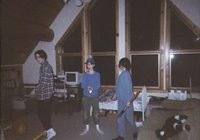 The kids putting on their own play, a loooong time ago.
"A key aspect of family life is working out how to do your own thing within the confines of conflicting resource allocation amongst the other family members." Innovative Families
So true! Also, check out the link for some examples of innovative family ideas. ... and add your own.
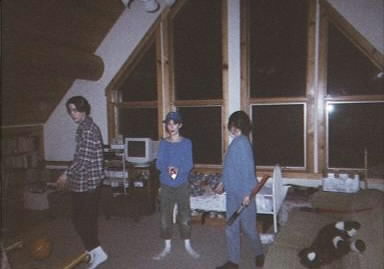 The kids putting on their own play, a loooong time ago.
When Unschooling Feels Chaotic
When daily life already feels quite chaotic for some reason (like a new baby, or some other life event that stirs up the routine), then a relaxed form of homeschooling can feel like surrendering to the chaos. So a mom has an intense desire to keep order in SOME area, and academics DO lend itself to orderly progression.
I go through workbook periods when I just want to sit my kids down at the table, have them work and produce nice neat little pages of standard academics, without Any Trouble To ME. If I look back at when I felt this desire most, it's usually when I've gotten just past a major life event. I have enough energy to take charge a little but not enough to cope with too much new input. Unschooling feels threatening because it is open-ended and unpredictable, then; it seems to require more personal resources than I have.
We have had some real successes with our unschooling "sabbatical" this fall. I wanted to mention that because every time I post I seem to be expressing my concerns and anxiety. But there have been so many GOOD times.
I think the most significant successes have been with ME. It's kind of difficult to explain. When I'm dealing with a standard planned curriculum and trying to impose it on my kids, I'm looking for a way to mold the kids to fit the curriculum OR mold the curriculum to fit the kids. Either way it's a bit awkward, and secondhand, somehow. But when I let go of that and start with the kids, it is more direct. I am working to find my way to what they need. It is more like what I am already doing as a mother.
To put it another way. When I read, say, Charlotte Mason's books and see what I "SHOULD" be doing, it makes it seem dry and like a matter of obligation. Then I procrastinate, and feel obligated to put it on my list of To Do's, and feel guilty when we don't get to it. Then I present it to my kids as a matter of duty, which inspires the same negative reaction in them.
When I read CM's books just looking for things we could be doing, that are worth doing, it's completely different. The intrinsic human value of the activities reasserts itself.
Another way to say it might be that my children tend to pick up on our REAL interests and passions and sense of duty. In other words, "do what I do, not just what I say." I think the great virtue of structured education in the home is that the kids see that education is important to the parents because the parents are demonstrating time and effort and commitment. But you can model that time and commitment and energy as an unschooler, as well.
About "laziness" -- there are two kinds. One is not doing what you should do, and the other is doing it unwillingly, because you feel compelled to. John Holt talked about the person who says "My kids should be forced to do schoolwork, because if I weren't forced to do what I should do, I wouldn't do it." He remarked that this is the mentality of a slave. He is absolutely correct in this; and furthermore, he is squarely in the mainstream of traditional classic and Catholic thought when he says this. Charlotte Mason talks about the importance of Will, of "cheerfully doing the very thing one would rather not do." We ought not to do things because we are forced to, but because we choose to because they are right.
I go through workbook periods when I just want to sit my kids down at the table, have them work and produce nice neat little pages of standard academics, without Any Trouble To ME. If I look back at when I felt this desire most, it's usually when I've gotten just past a major life event. I have enough energy to take charge a little but not enough to cope with too much new input. Unschooling feels threatening because it is open-ended and unpredictable, then; it seems to require more personal resources than I have.
We have had some real successes with our unschooling "sabbatical" this fall. I wanted to mention that because every time I post I seem to be expressing my concerns and anxiety. But there have been so many GOOD times.
I think the most significant successes have been with ME. It's kind of difficult to explain. When I'm dealing with a standard planned curriculum and trying to impose it on my kids, I'm looking for a way to mold the kids to fit the curriculum OR mold the curriculum to fit the kids. Either way it's a bit awkward, and secondhand, somehow. But when I let go of that and start with the kids, it is more direct. I am working to find my way to what they need. It is more like what I am already doing as a mother.
To put it another way. When I read, say, Charlotte Mason's books and see what I "SHOULD" be doing, it makes it seem dry and like a matter of obligation. Then I procrastinate, and feel obligated to put it on my list of To Do's, and feel guilty when we don't get to it. Then I present it to my kids as a matter of duty, which inspires the same negative reaction in them.
When I read CM's books just looking for things we could be doing, that are worth doing, it's completely different. The intrinsic human value of the activities reasserts itself.
Another way to say it might be that my children tend to pick up on our REAL interests and passions and sense of duty. In other words, "do what I do, not just what I say." I think the great virtue of structured education in the home is that the kids see that education is important to the parents because the parents are demonstrating time and effort and commitment. But you can model that time and commitment and energy as an unschooler, as well.
About "laziness" -- there are two kinds. One is not doing what you should do, and the other is doing it unwillingly, because you feel compelled to. John Holt talked about the person who says "My kids should be forced to do schoolwork, because if I weren't forced to do what I should do, I wouldn't do it." He remarked that this is the mentality of a slave. He is absolutely correct in this; and furthermore, he is squarely in the mainstream of traditional classic and Catholic thought when he says this. Charlotte Mason talks about the importance of Will, of "cheerfully doing the very thing one would rather not do." We ought not to do things because we are forced to, but because we choose to because they are right.
Tuesday, January 17, 2006
Sequoias and Adversity
 Giant "sequoias rely on fire to release most seeds from their cones, to expose bare mineral soil in which seedlings can take root, to recycle nutrients into the soil, and to open holes in the forest canopy through which sunlight can reach young seedlings." Mariposa Grove
John Muir "The Big Trees"
"There is no absolute limit to the existence of any (giant sequoia). Death is due to accidents, not, as that of animals, to the wearing out of organs. Only the leaves die of old age. Their fall is foretold in their structure; but the leaves are renewed every year, and so also are the essential organs wood, roots, bark, buds. Most of the Sierra trees die of disease, insects, fungi, etc., but nothing hurts the big tree. I never saw one that was sick or showed the slightest sign of decay. Barring accidents, it seems to be immortal. It is a curious fact that all the very old sequoias had lost their heads by lightning strokes. "All things come to him who waits." But of all living things, sequoia is perhaps the only one able to wait long enough to make sure of being struck by lightning."
Allegory of the Redwoods (not the same as the giant sequoia, according to Brendan, though some people get them mixed up -- the Redwood is "sequoia sempervirens" and the Giant Sequoia is "sequoia giganteum")
"But what may actually be more amazing than how big the redwoods are or how tall they stand is how long they stand and the fact that, despite their large, wind-catching limbs and their very shallow roots, they stand firm against the strongest storms and the wildest wind. Their secret is simple: Redwoods grow together in groves and intertwine their shallow roots. Thus, the roots of one tree in the grove are the roots of all the trees, interlaced underground and able to hold each tree upright no matter what kind of gale goes on above."
Sunday, January 15, 2006
When the Time Train Derails

Selkie writes about the "Time Traveller's Strife". I've been feeling what I've always thought of as the "Time Warp" In happened in 1997 when I was getting a routine ultrasound, and the doctor said, "they're twins" and then her face changed. I knew what she was going to say. It happened when we followed Aidan to a hospital in a major city 250 miles from where we lived, and the doctor told us "it's minute by minute" -- his best hope and that a slim one, was a liver transplant, but before he even went there he had to double his weight (hard to do without a working liver) and recover from transfusion-induced pneumonia -- his lungs had filled with fluid.
It happened again last Sunday when we went from routinely (sort of) dropping Liam off at the railroad station, to, one hour later, me holding Aidan's hand and desperately praying Memorares in the back seat as his lips turned pale blue and a trail of saliva came from the corner of his mouth. One hour after that I was watching him lie on the ER table while the doctors debated whether to put him on the ventilator or not. But an eternity went by during those hours.
It is only a week almost to the hour since that day. That's what I mean about time warp. The track seems relatively predictable most of the time. You may see some interesting sights and go through new areas, in fact you're guaranteed to. But when one of these other things happens, it's like you suddenly find yourself on a different track altogether. It loops and veers and when you rejoin the "Normal" track you've travelled miles and miles, but you're only a couple of feet further on your temporal journey.
It's like one of those "faster than light" space stories where the twin brother comes back 50 years older than the one that stayed at home.
You know, Chesterton was right about fairy tales.
Fairy tales are more than true - not because they tell us dragons exist, but because they tell us dragons can be beaten.
and so was Tolkien.
"The peculiar quality of...'joy' in successful Fantasy can...be explained eas a sudden glimpse of the underlying reality or truth. It is not only a 'consolation' for the sorrow of this world, but a satisfaction, and an answer to that question, 'Is it true?' The answer to this question that I gave at first was (quite rightly): 'If you have built your little world well, yes: it is true in that world.' That is enough for the artist...But in the 'eucatastrophe' we see in a brief vision that the answer may be greater--it may be a far-off gleam or echo or evangelium in the real world."
They are more real than the things everyone tells you are "real life". How shocking these time journeys would seem to me if I hadn't read about the prince turned to a frog and the hobbit carrying a ring that could destroy the world!
Fairy Tale Quotes
Moving out of Deschooling?
My question at 4real
What should a 4 year old know? (applies to older kids, too) -- thanks Leonie
From "Deschooling for Parents"
What should a 4 year old know? (applies to older kids, too) -- thanks Leonie
From "Deschooling for Parents"
"Some people like to see learning parceled out evenly over the year, over the week, or over a day. But life is lumpy. As with chaos theory, or statistics and probability, there are “busy” times and big quiet loops which seem to be going nowhere and actually have a destination. Think “leaps and bounds,” with rests in between.From What is Deschooling?Look directly at your child. Practice watching your child without expectations. Try to see what he is really doing, rather than seeing what he’s NOT doing. If you hold the template of “learning” up and squint through that, it will be harder for you to see clearly. Just look."
"Deschooling is a period of frustration, exhaustion and inquiry because it marks our transition from the prepackaged life of schooling to the uncharted world of homeschooling. As Catherine de Mauriac said to me, "In spite of the fact that we started in reaction to our perceptions of the inadequacies of our local district, now that we are in it, it would take wild horses to drag us out. It is a most amazing journey of discovery of ourselves, each other and the universe that we could not have even imagined the true character of the experience and can't completely conceive of where it will take us. It's not perfection, and mostly it's darn difficult. But what would we do in this life if we didn't take up a good challenge now and again?"
Rejecting the Pre-Packaged Life
"Part of the pre-packaged life Americans are issued is the idea that happiness comes after college, after home ownership, after the new car. The stick that holds that carrot will not bend. If happiness depends on performance and acquisition, how long will it last? How long is your car the newest on your street before unhappiness returns?
Here's a little paradigm shift for you to practice on. Perhaps happiness shouldn't be the primary goal. Try joy. Try the idea that it might be enJOYable to cook, to set the table, to see your family, rather than the idea that you'll be happy after dinner's done and cleaned up. My guess is that such happiness might last a couple of seconds before you look around and see something else between you and happiness. Joy, though, can be ongoing, and can be felt before, during and after the meeting of goals."
Planning and Scheduling part II
This is a continuation of Part I
Here's a few ways we've tried to cope with the demands of a larger family size and much more chaotic schedule while still trying to use Charlotte Mason principles of a "living" education-- none of these ideas are very original and all are sort of general, but keeping them in mind does seem to help us progress on the right track:
(1) Making learning an atmosphere. One way is by having access to materials: construction toys, good books, music, art supplies, the outdoors. Another way is to have sufficient free time. Another way is to foster the development of interests, both by being aware of the development of interests and talents in the children, and by modelling lifelong learning. I can honestly say I've learned more with my kids
watching my trial and error than I did as a kid myself. My husband is an excellent model of picking up new interests and developing skills without formal teaching.
(2) Short lessons. I know I am singing a familiar song to CM homeschoolers here! But it has been true in our family as well. I particularly like the Clarkson's distinction between discipline subjects and discovery subjects. Sometimes you can break the subject into two -- eg math involves drill, but it also involves discovery. For the discipline subjects or parts of subjects, which I feel aren't necessarily fun but are important, I set the timer and try to make a little progress every day. For the discovery subjects, I may not have a lot of time to guide my kids through every detail, but ideally I can inspire them by using good materials to want to learn more. Eg with several of my kids, one thing that has worked is reading aloud to them and discussing or narrating, then assigning them related reading or work. This works well for history, in particular, and literature studies.
(3) A combination of family learning and tutoring. All this year I've been teaching mostly by tutoring each kid in turn, then setting them off to complete work on their own. This works well, but leaves me feeling somewhat scattered and IMO loses some of the benefits of family learning. I'm going to experiment this summer with some family workshops, perhaps in religion, science or history. We have started the group writing workshop, and this has gone well. They have been motivated by each other. So I think that some more group learning might add some variety to our day and allow more sharing of learning. I think everyone has to find what works in their circumstances, but even if every child is working independently in their room, I think homeschooling has family learning benefits because it fosters a closeness and a shared goal.
(4) Organization: never quite enough around here, but it has helped to get a handle on things. I constantly refer to Leonie's "pegs" of habits based around mealtimes, etc. We are now trying to get the chores on a consistent rotation (I have 15, 13, 12, and 9yos all capable of doing many things around the house) so I will have less things on my to-do list. This training process is my main goal for this summer; it will be essential as we head into an involved third trimester, assuming it is God's will that we get that far, and I hope it is!
(5) Thinking in terms of "seasons": we find that fall is a more structured academics season; winter is the time for reading aloud, music, conversation over cocoa, projects, etc; spring is our nature study season, and summer is when we maintain academic skills, go on field trips and rabbit trails into hobbies and learning projects of interest, and experiment with the way we do things in preparation for next year. It's not a radical disconnect, but a transition from one focus to another, and provides variety with consistency.
I also think in terms of seasons in a broader sense -- the early years are the time for quiet, steady but vital development --concrete experience, foundation in literacy and numeracy, and foundation character qualities; the middle years are the time for exercising logic, comparing family views with the world's views, trying a variety of new skills; the older years of childhood (highschool) are a time for refining skills and worldviews, learning to work in an adult world and deal with more adult temptations and situations while still under a parent's guidance.
Obviously these also are transitions with much overlap, not rigid stages.
(6) Flexibility and patience -- realizing that things are going to be in flux and that we will have to not only adapt, but keep adapting, again and again. Charlotte Mason writes about training habits that a mother can get discouraged thinking of all the endless work ahead of her, but in actuality, it is like a clock -- only one tick at a time is needed. She says that a mom can actually get to enjoy and embrace her responsibility to train her children and I think this applies to adaptability too; we can learn to expect and embrace the necessity of adapting under God's providence, and this is actually perhaps an important learning skill to model to our children.
Here's a few ways we've tried to cope with the demands of a larger family size and much more chaotic schedule while still trying to use Charlotte Mason principles of a "living" education-- none of these ideas are very original and all are sort of general, but keeping them in mind does seem to help us progress on the right track:
(1) Making learning an atmosphere. One way is by having access to materials: construction toys, good books, music, art supplies, the outdoors. Another way is to have sufficient free time. Another way is to foster the development of interests, both by being aware of the development of interests and talents in the children, and by modelling lifelong learning. I can honestly say I've learned more with my kids
watching my trial and error than I did as a kid myself. My husband is an excellent model of picking up new interests and developing skills without formal teaching.
(2) Short lessons. I know I am singing a familiar song to CM homeschoolers here! But it has been true in our family as well. I particularly like the Clarkson's distinction between discipline subjects and discovery subjects. Sometimes you can break the subject into two -- eg math involves drill, but it also involves discovery. For the discipline subjects or parts of subjects, which I feel aren't necessarily fun but are important, I set the timer and try to make a little progress every day. For the discovery subjects, I may not have a lot of time to guide my kids through every detail, but ideally I can inspire them by using good materials to want to learn more. Eg with several of my kids, one thing that has worked is reading aloud to them and discussing or narrating, then assigning them related reading or work. This works well for history, in particular, and literature studies.
(3) A combination of family learning and tutoring. All this year I've been teaching mostly by tutoring each kid in turn, then setting them off to complete work on their own. This works well, but leaves me feeling somewhat scattered and IMO loses some of the benefits of family learning. I'm going to experiment this summer with some family workshops, perhaps in religion, science or history. We have started the group writing workshop, and this has gone well. They have been motivated by each other. So I think that some more group learning might add some variety to our day and allow more sharing of learning. I think everyone has to find what works in their circumstances, but even if every child is working independently in their room, I think homeschooling has family learning benefits because it fosters a closeness and a shared goal.
(4) Organization: never quite enough around here, but it has helped to get a handle on things. I constantly refer to Leonie's "pegs" of habits based around mealtimes, etc. We are now trying to get the chores on a consistent rotation (I have 15, 13, 12, and 9yos all capable of doing many things around the house) so I will have less things on my to-do list. This training process is my main goal for this summer; it will be essential as we head into an involved third trimester, assuming it is God's will that we get that far, and I hope it is!
(5) Thinking in terms of "seasons": we find that fall is a more structured academics season; winter is the time for reading aloud, music, conversation over cocoa, projects, etc; spring is our nature study season, and summer is when we maintain academic skills, go on field trips and rabbit trails into hobbies and learning projects of interest, and experiment with the way we do things in preparation for next year. It's not a radical disconnect, but a transition from one focus to another, and provides variety with consistency.
I also think in terms of seasons in a broader sense -- the early years are the time for quiet, steady but vital development --concrete experience, foundation in literacy and numeracy, and foundation character qualities; the middle years are the time for exercising logic, comparing family views with the world's views, trying a variety of new skills; the older years of childhood (highschool) are a time for refining skills and worldviews, learning to work in an adult world and deal with more adult temptations and situations while still under a parent's guidance.
Obviously these also are transitions with much overlap, not rigid stages.
(6) Flexibility and patience -- realizing that things are going to be in flux and that we will have to not only adapt, but keep adapting, again and again. Charlotte Mason writes about training habits that a mother can get discouraged thinking of all the endless work ahead of her, but in actuality, it is like a clock -- only one tick at a time is needed. She says that a mom can actually get to enjoy and embrace her responsibility to train her children and I think this applies to adaptability too; we can learn to expect and embrace the necessity of adapting under God's providence, and this is actually perhaps an important learning skill to model to our children.
Planning and Scheduling
This is an old post I wrote on the Catholic Charlotte Mason e-list, back when I was newly pregnant with my now-3-year-old. I went and retrieved it because it is THAT time of year, when I might need to reread it again. And because I hoped it might be helpful to someone else.
Yes, how true... how funny that I also was just having a loong phone conversation with a CM friend about these things, too; though there were lots of rabbit trails on the way. ... I am in the first trimester of my 9th pregnancy, counting tiny daughter and little twin boys who are with God. We are dealing with several medical issues with our youngest right now plus the ins and outs of the IEP process as he transitions from early intervention into the world of school services (would appreciate prayers). I am reading through MOTH quite seriously, knowing that I need to reshape my schedule AGAIN or I will disappear into the swamp! At the same time I am rereading my Charlotte Mason books because a schedule is a way to accomplish worthwhile things, not a worthwhile thing in itself. I don't want to forget why I am homeschooling and bringing up children in the actual process of doing it.
In "Jane Eyre", Rochester and Jane talk about the difference between love and possession. Rochester says with frustration that he could hold a bird in his hand -- but the bird's life would be gone beyond him. What he held would be a tiny dead frame, not what he valued -- its unique, precious vitality. I feel this is true of education too, and the journey towards God, and anything that involves a relationship. You can have the form, or what Charlotte Mason calls a "System" and yet the essence can escape. One extreme example is the children in orphanages, well cared for physically, who wilt and die because they have no human attachment; another extreme example is the Pharisees, who observed the outer forms of their religion so carefully that they lost sight of God. I know from experience that I can almost covet the safety of a safe, predictable form; I almost feel greedy for it sometimes. "Just tell me EXACTLY what to do, God, so I can do it and not have to discern anymore!"
But it is when I am forced to run around chasing the apples that God makes things simpler for me and makes me conscious of the real treasure I am stewarding, the apples, rather than the man-made convenience, the cart. No, He doesn't make it easy -- He doesn't pick up the apples for me, but I am conscious of Him as I scramble -- and cry over bruises... Another metaphor might be the men in Jesus's parable who were given the talents. The master didn't want them to just bury them in the ground and preserve them in safety; he wanted them to go and take risks and make them multiply. In the parable of the seeds, the ground that bore fruit was the fertile soil -- now I'm not much of a gardener, but fertile soil has to be turned and plowed, composted etc. Sometimes being open to God's providence whether by adding a new blessing, dealing patiently with needy relatives, taking the children out of school to teach them at home, adjusting one's homeschool style or whatever, whatever makes one realize one's neediness, can make one's life soil more receptive to His grace.
With education, I see from experience that a lot of learning depends just as much
on serendipity (Leonie's word) as on conscious intention on the part of the teacher. Even medically fragile children like my son fare better statistically at home than at hospitals where they are cared for by trained experts -- why is this? Preemies fare better when the bonding process with their mommies and daddies is encouraged even with a higher infection risk. Children in orphanages who were cuddled and nurtured by retarded teenagers developed normally, while their deprived peers failed to thrive. Homeschooled kids general do better academically than schooled ones even though their instruction is less systematic and less time-consuming, and less expensive. I think that is because learning is an active engagement, what Charlotte Mason calls a relationship, rather than an imparting of content. Relationships grow and are nurtured, like plants, as CM writes; they are not built like a skyscraper.
Yes, how true... how funny that I also was just having a loong phone conversation with a CM friend about these things, too; though there were lots of rabbit trails on the way. ... I am in the first trimester of my 9th pregnancy, counting tiny daughter and little twin boys who are with God. We are dealing with several medical issues with our youngest right now plus the ins and outs of the IEP process as he transitions from early intervention into the world of school services (would appreciate prayers). I am reading through MOTH quite seriously, knowing that I need to reshape my schedule AGAIN or I will disappear into the swamp! At the same time I am rereading my Charlotte Mason books because a schedule is a way to accomplish worthwhile things, not a worthwhile thing in itself. I don't want to forget why I am homeschooling and bringing up children in the actual process of doing it.
In "Jane Eyre", Rochester and Jane talk about the difference between love and possession. Rochester says with frustration that he could hold a bird in his hand -- but the bird's life would be gone beyond him. What he held would be a tiny dead frame, not what he valued -- its unique, precious vitality. I feel this is true of education too, and the journey towards God, and anything that involves a relationship. You can have the form, or what Charlotte Mason calls a "System" and yet the essence can escape. One extreme example is the children in orphanages, well cared for physically, who wilt and die because they have no human attachment; another extreme example is the Pharisees, who observed the outer forms of their religion so carefully that they lost sight of God. I know from experience that I can almost covet the safety of a safe, predictable form; I almost feel greedy for it sometimes. "Just tell me EXACTLY what to do, God, so I can do it and not have to discern anymore!"
But it is when I am forced to run around chasing the apples that God makes things simpler for me and makes me conscious of the real treasure I am stewarding, the apples, rather than the man-made convenience, the cart. No, He doesn't make it easy -- He doesn't pick up the apples for me, but I am conscious of Him as I scramble -- and cry over bruises... Another metaphor might be the men in Jesus's parable who were given the talents. The master didn't want them to just bury them in the ground and preserve them in safety; he wanted them to go and take risks and make them multiply. In the parable of the seeds, the ground that bore fruit was the fertile soil -- now I'm not much of a gardener, but fertile soil has to be turned and plowed, composted etc. Sometimes being open to God's providence whether by adding a new blessing, dealing patiently with needy relatives, taking the children out of school to teach them at home, adjusting one's homeschool style or whatever, whatever makes one realize one's neediness, can make one's life soil more receptive to His grace.
With education, I see from experience that a lot of learning depends just as much
on serendipity (Leonie's word) as on conscious intention on the part of the teacher. Even medically fragile children like my son fare better statistically at home than at hospitals where they are cared for by trained experts -- why is this? Preemies fare better when the bonding process with their mommies and daddies is encouraged even with a higher infection risk. Children in orphanages who were cuddled and nurtured by retarded teenagers developed normally, while their deprived peers failed to thrive. Homeschooled kids general do better academically than schooled ones even though their instruction is less systematic and less time-consuming, and less expensive. I think that is because learning is an active engagement, what Charlotte Mason calls a relationship, rather than an imparting of content. Relationships grow and are nurtured, like plants, as CM writes; they are not built like a skyscraper.
Saturday, January 14, 2006
They "need" to be made to learn
That "necessity" point is an interesting one. If I always caught my child before she fell, perhaps she'd learn to depend on me to keep her from falling every time she walked. Perhaps she'd even started getting angry at me when I didn't get there in time. (More likely, given human nature, she'd start glaring at me whenever she made her walking attempts, saying "Me do it!") In other words, it's possible to artifically tamper with the connection between necessity and learning.... to break the circuit. It's also a strong temptation for an older, more experienced person to want to "help" the younger novice too much. You see that with the 5 year old officiously "helping" his little sister walk, the toddler usually bitterly angry and both of them in danger of falling : )
It seems to me that our teaching or non-teaching methods have "meta-lessons" built in. I see the "meta-lesson" in unschooling (ideally) as being confidence in the human ability to learn new things for good reasons. An unschooled child might perhaps be more likely to jump in and learn to do his own taxes, as an adult, than a conventionally schooled child who was taught by implication that he had to be taught everything new.
At any rate, most of the adults I know who are willing to learn new skills through life are people who as kids developed confidence in their own ability to learn. And often, from what I've seen, this confidence came from the "unschooling" (self-directed, independent) part of their life. In other words, what they did because they chose to, freely.
It seems to me that our teaching or non-teaching methods have "meta-lessons" built in. I see the "meta-lesson" in unschooling (ideally) as being confidence in the human ability to learn new things for good reasons. An unschooled child might perhaps be more likely to jump in and learn to do his own taxes, as an adult, than a conventionally schooled child who was taught by implication that he had to be taught everything new.
At any rate, most of the adults I know who are willing to learn new skills through life are people who as kids developed confidence in their own ability to learn. And often, from what I've seen, this confidence came from the "unschooling" (self-directed, independent) part of their life. In other words, what they did because they chose to, freely.
The Unfinished Process of Thought
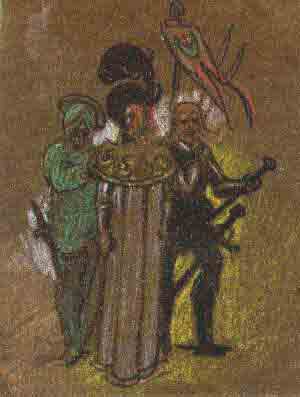
In the Oct./Nov Gilbert Magazine, there is an article by GK Chesterton from 1929 called "The Inefficiency of Science". It seems to fit in with the thoughts I've been having about WHY homeschooling can work (depending on whose standards of "work" you are using, of course, but isn't that the very crux of the issue?)
He writes that science is a succession of hypotheses:
"What is the matter with the scientific hypothesis, as a help about marriage or education or hygiene, is that even when it has really proved something, we can never tell what the things itself will ultimately prove. Therefore if we act upon it at any given moment, in relation to any given problem, we are always acting on an unfinished process of thought, which, even if it is never falsified in theory, will almost certainly be falsified in fact."
The example he gives is of Professor A, who declaims that since Noses are repositories of 90% of the body's germs, nose removal surgery for everyone will forestall most of the illnesses to which we are subject. Once all the noses are removed, PRofessor B shows that germs have multiplied all over the human body. Professor C then discovers that indeed, noses are repositories for germs, and that that is their purpose, to provide a kind of barrier or airlock to keep germs from the rest of the body. None of the professors have contradicted each others' findings, but the final discovery contradicts the implications acted upon by the first discovery.
He goes on:
"It would be easy to illustrate the same thing from education; for our schools are swept nowadays with wave after wave of scientific speculation: by fad after fad and fashion after fashion. They are generally notions quite new even in the scientific world; and each one of them will probably be shown by science to be the same sort of double-edged weapon. I am quite unable to imagine why we should say in such cases that we are educating the children. I could understand it if we said we were educating the educators, by giving them a crowd of children on whom to experiment. It would be comprehensible if considered as a sort of more or less humane vivisection. But the scalpel of the vivisectionist will again be found to be a weapon that cuts both ways. If the scientific educationist is really ready to learn from his own experiences in educating the children, the thing he will probably learn, under these conditions, is that his way of educating them has been entirely wrong. For these notions are, in their very nature, hypotheses to be tested and not truths to be taught."The picture is a sketch done by GKC
Severe Storm Warnings
 This is not our outside view but it looks a lot like it right now. I spent a happy hour this morning shovelling out the mini-glacier on our deck. When I say that our deck is below an intersection of two angles on our roof, all those with metal roofs and heavy snowfall will understand.
This is the first year since we've moved here that I've been able to get out there and just dig in the deck. I've always been pregnant, had a toddler that needed watching, or a sick child. Our "sick child" Aidan looked pretty bright and healthy as he glued his face to the glass deck door and watched my efforts intently. A kind of active vigil that kept me happy and motivated as I chipped away at sedimentary layers of hail, frozen snow and ice.
Friday, January 13, 2006
Classical Education and Unschooling
 Found this really good post online. I wonder if I know the author; it sounds like it could be one of my wonderful 4reallearning friends~ !
I’ve wondered many times if the things I’ve posted on this board in the past have given a simplistic view of our family’s educational life. Our school has never been structured like a traditional school, but there has always been structure. Our structure has been influenced by many learning philosophies. We don’t follow any of these exactly, but we have been influenced by Charlotte Mason (no twaddle, real books/great literature, art, classical music, nature studies, narration), the Moores (relax, use the world around us as a curriculum, simplicity), classical education (great books, ideas, understanding the classical influence on our culture and filtering it through Biblical truth, developing thinkers) I’ve also been influenced by some of the ideas in other methods, by articles I’ve read, and by books I’ve read. So, we’ve come up with our own philosophy and methods of learning, taking ideas from here and there because it seemed natural for our family to do so. We have a structure, but not a detailed plan. We have educational goals, but our methods of accomplishing them are challenging and require a lot of energy because we work to motivate the kids to learn for themselves in a deep and meaningful way. It’s harder to motivate a child to read Plato than it is to assign him the reading.The whole main site looks good.
Thursday, January 12, 2006
Ludus Sanae Mentis
I remember finding this site when I first surfed on the internet about seven years ago now.
In Homeschooling from Birth, NS Gill writes:
In Homeschooling from Birth, NS Gill writes:
Most of the year we go along using a relaxed schedule in which my son is free to work on his games, playing, and reading, interrupted for only a couple of hours to deal with schooly stuff and intermittently for chores. However, there are at least two months when we go through intense work. One is in April as we prepare for the annual test. Minnesota homeschoolers are required by law to take a nationally norm-referenced standardized achievement test each year. If their performance is below the thirtieth percentile, the parent is required to seek further evaluation. When my son was to take his first test, I worried because he couldn't read. I explained this to Tom Murray, the Minneapolis Public School's homeschool liaison, who said it sounded as though I'd already provided evaluation, so not to worry. Except for that month each year, the test seems so remote that I can't remember if my son ever actually scored below the thirtieth percentile.Hmm, this fall month thing sounds like a possibility to ponder. Also see Tidal Homeschooling for a different version of the same concept. I have to figure out where to go from our fall "sabbatical". The next step is to figure out how unschooling can fit in with classical education, if indeed it can. So many people seem to think it can't.The other month is in the fall--probably a residue of my own schooling. Anyway, I feel excited enough then to tackle new subjects in depth, The first official year we combined learning about frogs with starting a support group. Last year we tackled Ancient Egypt, reading Eloise Jarvis McGraw's The Golden Goblet and all the books we could find in the children's library on Egypt until the information became hopelessly repetitive. As a related project we studied geometry.

"What I believe is the main philosophy of unschooling is to refrain from teaching a child that it needs to be taught."
That's a quote from "Unschooling and the Need to Know".
Also, I'm in Carnival of Unschooling #2!
And so is Melissa, in "Tidal Homeschooling"!
Also, I'm in Carnival of Unschooling #2!
And so is Melissa, in "Tidal Homeschooling"!
Quotes to Think About Today
Leonie in On Mary and Mothering, quotes Scott Hahn:
After two hospitalizations, the first for a long time, I find myself floundering a bit.
WB Yeats wrote in The Second Coming "Things fall apart, the centre cannot hold....." -- for some reason, ever since I read the Chinua Achebe novel of this name back in high school, this has always summed up my human-nature response to calamity and grief.
The terrible secret of the universe:
Leonie describes her One Thing concept. My "One Thing" recently, since that horrible evening in the Emergency Room where Aidan was not breathing, has been to look into Aidan's beautiful brown eyes. They are so full of joy and hope. It is like an antidote to that terrible Second Coming:
His bright, expectant eyes remind me of the power of the powerless, the power of the hidden, little things of life. The paradox of the Beatitudes. And of the Nativity.
"Mothers are the most difficult people to study. They elude our scrutiny. By nature and by definition, they are relational. They can be considered as mothers only in their relationship with their children. That is where they focus their attention, and that is where they would focus ours.""Mothers are the most difficult people to study. They elude our scrutiny. By nature and by definition, they are relational. They can be considered as mothers only in their relationship with their children. That is where they focus their attention, and that is where they would focus ours."In Synergy, she quotes Stephen Covey:
"Synergy...is the magic that happens when one plus one equals three - or more. And it happens because the relationship between the parts is a part itself. It has such catalytic, dynamic power that it affects how the parts interact with one another. ...There is a mystery here that I've noticed before. A lot of what REALLY is going on in life is the parts between the parts.
So, synergy deals with the part between the parts. In the family, this part is the quality and nature of the relationship between people. ..."
After two hospitalizations, the first for a long time, I find myself floundering a bit.
WB Yeats wrote in The Second Coming "Things fall apart, the centre cannot hold....." -- for some reason, ever since I read the Chinua Achebe novel of this name back in high school, this has always summed up my human-nature response to calamity and grief.
The terrible secret of the universe:
"Turning and turning in the widening gyre /The falcon cannot hear the falconer.... The best lack all convictions, while the worst /Are full of passionate intensity."This is my human response, I say, but I know there's more to it than that. Somehow, to me, what the quotes say about relationships, about the sum of two parts being more than two, are at the heart of it.
Leonie describes her One Thing concept. My "One Thing" recently, since that horrible evening in the Emergency Room where Aidan was not breathing, has been to look into Aidan's beautiful brown eyes. They are so full of joy and hope. It is like an antidote to that terrible Second Coming:
"And what rough beast, its hour come round at last/
Slouches towards Bethlehem to be born? "
His bright, expectant eyes remind me of the power of the powerless, the power of the hidden, little things of life. The paradox of the Beatitudes. And of the Nativity.

Zone or Focus Tasks
(This is the rotation of things to be done Thursdays)
I'm on an organizing tear. I woke up and realized that I've been unable to do much beyond the minimum around the house, for pretty good reason. Besides the holidays, we all got the flu and Aidan went to the hospital a couple of times.
I still get tired easily when I actually DO to much (or that's my alibi ;-)) so I decided to devote this deep cleaning day to reorganizing my system. So I can sit around on the computer and still feel like I'm being organized (!!) I have this all on individual cards, by the way, color-coded -- yellow for daily, blue for weekly, green for monthly, pink for seasonal. I know Flylady said this was too complicated but for me, it works better than lists. I can shuffle and sort -- I think I'm a kinesthetic thinker in that way.
So this below is the list form of my green index cards. Here are my zones:
ZONE 1: Entrance, Front Porch and Back Porch, Garage and Kitchen
ZONE 2: Bathrooms and Hall Closets
ZONE 3: Bedrooms -- Kids and Master
ZONE 4: Living Room and Loft, Dining Room
ZONE 5: Personal -- Kids Health and medical, Family Matters
Thursday is also the day to collect trash from around the house.
Monthly Jobs are done during this day, and I also pick 1 or 2 Seasonal Jobs each time.
Monthly Jobs:
Zone 1: Clean entrance, kitchen, front and back porch, garage, coat closet
I'm on an organizing tear. I woke up and realized that I've been unable to do much beyond the minimum around the house, for pretty good reason. Besides the holidays, we all got the flu and Aidan went to the hospital a couple of times.
I still get tired easily when I actually DO to much (or that's my alibi ;-)) so I decided to devote this deep cleaning day to reorganizing my system. So I can sit around on the computer and still feel like I'm being organized (!!) I have this all on individual cards, by the way, color-coded -- yellow for daily, blue for weekly, green for monthly, pink for seasonal. I know Flylady said this was too complicated but for me, it works better than lists. I can shuffle and sort -- I think I'm a kinesthetic thinker in that way.
So this below is the list form of my green index cards. Here are my zones:
ZONE 1: Entrance, Front Porch and Back Porch, Garage and Kitchen
ZONE 2: Bathrooms and Hall Closets
ZONE 3: Bedrooms -- Kids and Master
ZONE 4: Living Room and Loft, Dining Room
ZONE 5: Personal -- Kids Health and medical, Family Matters
Thursday is also the day to collect trash from around the house.
Monthly Jobs are done during this day, and I also pick 1 or 2 Seasonal Jobs each time.
Monthly Jobs:
Zone 1: Clean entrance, kitchen, front and back porch, garage, coat closet
- Wax kitchen floor
- Clean oven
- Wipe door frames: garage, Frodo's room, porch door
- Wash entrance walls
- Bathe dog
- Wipe/wash shoes and boots
- Clean and organize cupboards and drawers
- Clean, polish tile
- Clean shower stall
- Wash shower curtain
- Wash scatter rugs
- Wipe walls
- Scour toilets with bleach, toothbrush etc
- Dust pictures
- Wash bathroom glasses, organize counter/shelf-top
- Clean under beds
- Dust picture frames
- Clean closets and organize
- Dust cobwebs
- Wipe furniture
- Wash bedding
- Clean windows and frames
- Vacuum thoroughly
- Spray/wash trash cans from all over house
- Mop upstairs floor
- Vacuum with hose upstairs
- Dust ledges
- Vacuum under cushions
- Clean windows
- Wash, straighten ornaments
- Dust picture frames
- Clean cobwebs, dust fans
- Dust lamp shades
- Move furniture and vacuum under
- Vacuum books
- Wipe small electronics, and other surfaces
- Haircuts
- Order Aidan's meds
- Bookkeeping, pay bills,
- give Clare clothing allowance
- Allocate other expenses
- Check next month's dates: Saints Days and app'ts
- Special dinner: Eg Candlelight
- Weigh and measure kids
- Load 5 boxes of giveaways and take to Goodwill on next trip to town
- Write article
- Family council
Seasonal Checklist
Here is the breakdown of my seasonal jobs. Basically, I'm supposed to focus on one or two of these per week during the relevant month. This one is going to need revision because it's a new thing. If this all looks very overwhelming, keep in mind that I'm building it a step at a time as I feel I can handle a new thing. If it looks sort of anal, it's NOT. I'm not a type-A but because I'm not, I have to fake it a bit. I find that if I have these things on a time-triggered system, and they come up BEFORE they become disasters, then I have time to sort through my angst and laziness about some of them. For some reason, these seasonal infrequent jobs are big procrastination issues for me, much more than my daily or weekly routines. I think it's because I like the status quo, don't care much for new things, and by the time they normally occur to me, it's usually already a crisis. For example, I put off my son's root canal much too long and then had to jam it into a holiday week when he was still recovering from the flu. Um, NOT ideal. I want to avoid that kind of thing as much as possible.
January
January
- make dental appointments
- change filter
- wash humidifier filter
- college/vocational planning
- update portfolios and booklists
- measure kids
- shampoo carpets
- wipe blinds
- clean chandelier, fans and other high things
- clean medicine cabinet
- Lent prep
- sort seasonal clothing
- buy new clothing as necessary
- plan garden
- car maintenance
- homeschool planning and ordering
- make list of home/yard repairs and improvements
- baseball sign-ups
- start clearing land outside
- plant garden
- plan June birthdays
- clean furnace vents
- have chimney cleaned
- plan for camping/update supplies
- well care doctor's check-ups
- football camp sign-up
- dentist appointments
- stain deck or outside of house
- fix driveway
- buy homeschool supplies as needed
- sort seasonal clothing
- buy new clothing
- start prepping outside for winter
- turn mattresses
- flu shots
- Advent & early Christmas prep
- update portfolios and booklists
- measure kids
- shampoo carpets
- wipe blinds
- clean chandelier, fans and other high things
- clean medicine cabinet
- Christmas prep & activities
- buy homeschool supplies
- pre-plan January and February birthdays
Daily 1-2-3
My friend told me about Flylady's "dancing" concept. I can't find it online but here's her routines.
Anyway, I have been thinking for a while about arranging my daily cards in "clusters". Why? Now that I'm more habituated, having a single card for each duty is a little too much reminding. But I always get overwhelmed by huge to do lists or detailed routines. So I re-did my yellow cards so that each one is in a cluster of three. The idea is that they'll be associated in my mind so I will be on auto-pilot, which is good, auto-pilot for automated tthings:
These are roughly in order of how they occur in the day:
-------------------
Daily, AM
-------------------
Daily, PM
---------------------
Anyway, I have been thinking for a while about arranging my daily cards in "clusters". Why? Now that I'm more habituated, having a single card for each duty is a little too much reminding. But I always get overwhelmed by huge to do lists or detailed routines. So I re-did my yellow cards so that each one is in a cluster of three. The idea is that they'll be associated in my mind so I will be on auto-pilot, which is good, auto-pilot for automated tthings:
These are roughly in order of how they occur in the day:
-------------------
Daily, AM
-------------------
- Get up, morning offering
- Start fire
- Start coffee, let dog out
- Defrost/plan dinner
- Make breakfast
- Scoop kitty litter
- Scour kitchen sink
- Polish faucet
- Wipe dishwasher door and bring cloth to laundry room
- Start laundry
- Shake scatter rugs in kitchen
- damp mop or sweep
- Make bed
- Straighten room
- Tidy bedside table
- Look at cards for day
- Look at calendar
- Food journal
- Exercise
- Massage Aidan
- Get "babies" dressed
- Aidan's meds
- Aidan's stretching and brace
- Write and decode with Aidan
- Aidan's speech and OT homework
- Paddy -time
- Table Time
- Math
- Religion
- Supervise chores
- Kevin's Lunch (and everybody)
- Bring cups and plates downstairs
- Read or exercise
Daily, PM
---------------------
- Clean sink
- Clean toilet
- Clean bathtub
- Rest
- Read
- Bathe
- Prayer
- Tame Closet Dragon (10 minutes)
- Inventory/Envision
- Put kids' cards in slots/update mine
- Set up coffee maker
- boil water for tea/hot chocolate
- tidy loft (room rescue with kids)
- Set table
- PRepare meal
- Exercise
- Wipe counters after dinner
- Wash pots and pans
- Tidy downstairs
- Check calendar
- Make to do list
- Lay out clothes for next day
- Brush teeth and remind kids
- Aidan's meds
- Family prayers
- Brush Aidan
- PT stretching
- Read Stories
- Music CD?
- Bed by 9:30
- Examen
- Spiritual reading
- Knitting, reading, time with Kevin -- RELAX
Wednesday, January 11, 2006
Sickness
I am bringing this over from Aidan's old caringbridge site. As you might guess, Aidan's relatives read Caringbridge so I wrote this in a cheerful way so as to reassure them.
-----------------
January 3rd
------------------
A few days after Christmas our whole family came down with some sort of respiratory virus. We thought it was Influenza but apparently it wasn't (more on that later). Anyway, one of us after another succumbed to a moderately high temp, general lassitude and aching, and then on to sniffles and coughing.
Aidan seemed to have one of the milder doses in the family range but on New Years' Eve (of course) he started getting quieter and more withdrawn. I brought out his pulse oximeter for the first time in about 2 years, to measure his Oxygen Sats, and he was too low -- in the mid to upper-80's. That is enough to account for low energy and irritability, which is what he was displaying. He was also running a temperature for the first time during this virus.
We put him on the oxygen we had from his earlier illnesses. A liter kept him in the upper-90 range for the night, but in the morning he still seemed too quiet and was breathing with some effort. We ended up calling the doctor who advised us to take him into the emergency room for a chest X-ray.
To make a long story short, the X ray showed something in his left lung and so they decided to consider it a mild pneumonia and admit him to the hospital. They did a blood culture and started him on antibiotics.
The ER nurse and phlebotomist were able to get an IV started with one poke AND draw blood, which in Aidan's history is simply wonderful good fortune. He coped beautifully, requesting a sticker, and saying, "I am being brave!" which made the nurse almost cry. Actually, he cashed out in stickers, since the X ray technician gave him a few too.
He was discharged about noon today. The culture was negative so apparently his pneumonia is viral rather than bacterial, but they are keeping him on oral antibiotics for a few days just to make sure, I guess. I, Aidan's mom, stayed with him for the 48 hours while Kevin, his dad, took 3 year old Paddy home to the other sick kids. There was a significant ice storm and several power outages to make their life adventurous while we were gone. I'm not sure who had it worse, but it is good to be reunited with a clear sky over our heads again. That was a long 48 hours for everyone, especially since I was sick and considered in isolation too, so I couldn't get to the cafeteria. They brought me meals and some coffee, but not enough of the latter!
Last Monday Aidan's MIckey G Tube came out and we had to run to the GI clinic to get a new one on Tuesday. So this past week has been quite medically eventful all things considered. I hope that is our share of hospitalizations for 2006. Time will tell!
----------------
January 8th
--------------
It's been a long time since Aidan has had two medical updates in a week's time! (see journal history for earlier entries).
Friday afternoon Aidan had a mild seizure. I think it was what they call a "partial seizure". He did not lose consciousness or become complete unresponsive. Rather, he started staggering around the living room, talking incoherently, and then leaned against the couch, gagging and retching. I helped him get on and he told me "I'm going to sleep" but the focus of his eyes started to drift upwards and to the left, which is what has happened in former seizures.
I brought him upstairs, trying to talk to him and keep him in the picture. He was shaking but not jerking the way he has in former seizures. Upstairs, he started talking and acting more clearly, and then fell asleep immediately and deeply, still with a dirty diaper (he had become incontinent during the seizure).
I called the pharmacist and he said that one of Aidan's antibiotics can sometimes cause seizures. So I called the doctor, the "hospitalist" at the hospital where Aidan had stayed. He thought under the circumstances, since the antibiotics were mostly a precaution anyway, that we should discontinue them.
Since then Aidan has been acting great. He ran a low temperature that night, but not since then. He still has a cold -- but we all do. His breathing has been great. In fact, Brendan's "sats" are lower than Aidan's -- Brendan's are hanging out in the low to mid 90's, and Aidan's are in the mid- to upper -90's -- great considering that we are at over a mile-high altitude.
Today Aidan is coming down with us to take his oldest brother Liam to the train station to return to college. We are not looking forward to that!
-----
January 10th
------------
Aidan's had quite a couple of weeks medically. Most recently he had a seizure while we were in town taking his oldest brother Liam to the Amtrak station to return to college. The seizure started out as a partial one, like the one last Friday (see Journal History), but then became a full-blown one. We drove him to the Children's Hospital, where his Daddy brought him into the ER at a run and called for immediate medical attention. He was taken straight back to a table and given Oxygen and an IV started for Ativan (a sedative to halt the seizure).
Finally the seizure stopped, but by that time Aidan had stopped breathing on his own... he was not "moving air" -- as they said -- his chest was not rising and falling. The respiratory technician was giving him oxygen and breathing for him through the bag, but they had to decide whether to put him on a respirator or not. While trying to decide, they tried to draw blood from the artery, and this kicked him back into gear, almost literally, since he struggled and kicked and then started breathing again on his own.
After this, he slept for quite a long time due to the seizure and the sedative. He stayed in the ER overnight for observation and because the ICU and general ward were both full. Then he was moved to a general care unit the next day, and was discharged today.
He seems fine -- still recovering from the flu, but otherwise his normal self.
We are to see his neurologist in the next month or two, but they have not put him on a seizure med -- they left us to decide that, and we thought it made more sense to wait and see. His seizures are certainly scary, but they have been infrequent, and under normal circumstances we would have his seizure meds with us and be able to give them to him. If he starts seizing more frequently, the picture might look a bit differently both to us and to the neurologist.
His occupational therapist says that also, it might be a good idea to have some cranio-sacral therapy done when he has been ill since the seizures tend to happen when he is sick, and the cranio-sacral work has had some beneficial results with some people with a seizure disorder.
------------
February 5
---------------
It's Sunday and I, Aidan's mom, have some free time on my hands since everyone else is watching the Superbowl! So I thought I would write a "good" update, since I think Aidan's grandma is absolutely right that the good times are important to write about too.
Aidan has been doing very well since his pneumonia and seizure. He had a cold last week and ran a temperature, but was over it quickly.
He is learning his alphabet and knows almost all the letters. We are starting to work on words now. He can recognize his name, "Aidan", and also "Pikachu" (his favorite Pokemon)
His favorite thing to do besides going to Grandma's house is going outside to play in the snow. We still have quite a lot in our front yard, even though it's been in the 50's. He tried sledding last week -- loved it!
He just helped me make pizza, our Sunday tradition.
His occupational and speech therapists haven't been able to come as often this winter because of illness and weather, but though he misses their visits when they do not come, he seems to be progressing pretty well.
-----------------
January 3rd
------------------
A few days after Christmas our whole family came down with some sort of respiratory virus. We thought it was Influenza but apparently it wasn't (more on that later). Anyway, one of us after another succumbed to a moderately high temp, general lassitude and aching, and then on to sniffles and coughing.
Aidan seemed to have one of the milder doses in the family range but on New Years' Eve (of course) he started getting quieter and more withdrawn. I brought out his pulse oximeter for the first time in about 2 years, to measure his Oxygen Sats, and he was too low -- in the mid to upper-80's. That is enough to account for low energy and irritability, which is what he was displaying. He was also running a temperature for the first time during this virus.
We put him on the oxygen we had from his earlier illnesses. A liter kept him in the upper-90 range for the night, but in the morning he still seemed too quiet and was breathing with some effort. We ended up calling the doctor who advised us to take him into the emergency room for a chest X-ray.
To make a long story short, the X ray showed something in his left lung and so they decided to consider it a mild pneumonia and admit him to the hospital. They did a blood culture and started him on antibiotics.
The ER nurse and phlebotomist were able to get an IV started with one poke AND draw blood, which in Aidan's history is simply wonderful good fortune. He coped beautifully, requesting a sticker, and saying, "I am being brave!" which made the nurse almost cry. Actually, he cashed out in stickers, since the X ray technician gave him a few too.
He was discharged about noon today. The culture was negative so apparently his pneumonia is viral rather than bacterial, but they are keeping him on oral antibiotics for a few days just to make sure, I guess. I, Aidan's mom, stayed with him for the 48 hours while Kevin, his dad, took 3 year old Paddy home to the other sick kids. There was a significant ice storm and several power outages to make their life adventurous while we were gone. I'm not sure who had it worse, but it is good to be reunited with a clear sky over our heads again. That was a long 48 hours for everyone, especially since I was sick and considered in isolation too, so I couldn't get to the cafeteria. They brought me meals and some coffee, but not enough of the latter!
Last Monday Aidan's MIckey G Tube came out and we had to run to the GI clinic to get a new one on Tuesday. So this past week has been quite medically eventful all things considered. I hope that is our share of hospitalizations for 2006. Time will tell!
----------------
January 8th
--------------
It's been a long time since Aidan has had two medical updates in a week's time! (see journal history for earlier entries).
Friday afternoon Aidan had a mild seizure. I think it was what they call a "partial seizure". He did not lose consciousness or become complete unresponsive. Rather, he started staggering around the living room, talking incoherently, and then leaned against the couch, gagging and retching. I helped him get on and he told me "I'm going to sleep" but the focus of his eyes started to drift upwards and to the left, which is what has happened in former seizures.
I brought him upstairs, trying to talk to him and keep him in the picture. He was shaking but not jerking the way he has in former seizures. Upstairs, he started talking and acting more clearly, and then fell asleep immediately and deeply, still with a dirty diaper (he had become incontinent during the seizure).
I called the pharmacist and he said that one of Aidan's antibiotics can sometimes cause seizures. So I called the doctor, the "hospitalist" at the hospital where Aidan had stayed. He thought under the circumstances, since the antibiotics were mostly a precaution anyway, that we should discontinue them.
Since then Aidan has been acting great. He ran a low temperature that night, but not since then. He still has a cold -- but we all do. His breathing has been great. In fact, Brendan's "sats" are lower than Aidan's -- Brendan's are hanging out in the low to mid 90's, and Aidan's are in the mid- to upper -90's -- great considering that we are at over a mile-high altitude.
Today Aidan is coming down with us to take his oldest brother Liam to the train station to return to college. We are not looking forward to that!
-----
January 10th
------------
Aidan's had quite a couple of weeks medically. Most recently he had a seizure while we were in town taking his oldest brother Liam to the Amtrak station to return to college. The seizure started out as a partial one, like the one last Friday (see Journal History), but then became a full-blown one. We drove him to the Children's Hospital, where his Daddy brought him into the ER at a run and called for immediate medical attention. He was taken straight back to a table and given Oxygen and an IV started for Ativan (a sedative to halt the seizure).
Finally the seizure stopped, but by that time Aidan had stopped breathing on his own... he was not "moving air" -- as they said -- his chest was not rising and falling. The respiratory technician was giving him oxygen and breathing for him through the bag, but they had to decide whether to put him on a respirator or not. While trying to decide, they tried to draw blood from the artery, and this kicked him back into gear, almost literally, since he struggled and kicked and then started breathing again on his own.
After this, he slept for quite a long time due to the seizure and the sedative. He stayed in the ER overnight for observation and because the ICU and general ward were both full. Then he was moved to a general care unit the next day, and was discharged today.
He seems fine -- still recovering from the flu, but otherwise his normal self.
We are to see his neurologist in the next month or two, but they have not put him on a seizure med -- they left us to decide that, and we thought it made more sense to wait and see. His seizures are certainly scary, but they have been infrequent, and under normal circumstances we would have his seizure meds with us and be able to give them to him. If he starts seizing more frequently, the picture might look a bit differently both to us and to the neurologist.
His occupational therapist says that also, it might be a good idea to have some cranio-sacral therapy done when he has been ill since the seizures tend to happen when he is sick, and the cranio-sacral work has had some beneficial results with some people with a seizure disorder.
------------
February 5
---------------
It's Sunday and I, Aidan's mom, have some free time on my hands since everyone else is watching the Superbowl! So I thought I would write a "good" update, since I think Aidan's grandma is absolutely right that the good times are important to write about too.
Aidan has been doing very well since his pneumonia and seizure. He had a cold last week and ran a temperature, but was over it quickly.
He is learning his alphabet and knows almost all the letters. We are starting to work on words now. He can recognize his name, "Aidan", and also "Pikachu" (his favorite Pokemon)
His favorite thing to do besides going to Grandma's house is going outside to play in the snow. We still have quite a lot in our front yard, even though it's been in the 50's. He tried sledding last week -- loved it!
He just helped me make pizza, our Sunday tradition.
His occupational and speech therapists haven't been able to come as often this winter because of illness and weather, but though he misses their visits when they do not come, he seems to be progressing pretty well.


Subscribe to:
Posts (Atom)