Saturday, September 30, 2006

Liturgical Year -- The Archangels

I like this post by Faith on the Liturgical Year — and also a bit about blending Waldorf and Catholicism. Now I understand better why the Baldwin Project has so many books about saints.

Here is a good site about the Archangels. They are particularly important to us this time of year.

Friday, September 29, 2006

Hiatus

I'm dealing with some technical difficulties with this blog site. A couple of my posts appear to have disappeared into cyberspace, and some others republish several times so I have to go back and delete the redundant ones; so until the struggles with the technology resolve, I'm going to be mostly posting on my homeschooljournal site.

Hiddenness

Today I read in my devotions a passage by St Vincent de Paul about imitating the hiddenness of Christ:

"Remember always that the Son of God remianed unrecognized. That is our aim, and that is what he asks of us now, for the future, and for always, unless he shows us, by some method of his which we cannot mistake, that he wants something else of us. Pay homeage to the everyday life led by our Lord on earth, to his humility, to his self-surrender, and his practice of the virtues such a life requires. But chiefly pay homage to the limitations our Divine Master set on his own achievements. He did not choose to do all he might have done, and he teaches us to be content to refrain from undertakings which might be within our power, and to fulfill only what charity demands and his will requires."
This seems to apply to me to some of our homeschooling-mom concerns about "doing it all", put into words by Julie and Elizabeth, among others. Do we really have to? There is no obvious practical solution given in St Vincent's words, but there IS a clear counter-pull to the message of constant activity -- we DON'T have to do it all to be faithful. There is growth in silence and hiddeness. Fields bear better crops if there are some seasons of quiet and "plowing under".

A translation of one of John Paul's poems, written as if in Christ's words, seems to me to strike the same note of "hiddenness":

Learn from me, my dear ones, how to hide,
for where I am hidden I abide....
[T]here is a Beauty more real
concealed in the living blood.

A morsel of bread is more real
than the universe,
more full of existence, more full of the Word —
a song overflowing, the sea,
a mist confusing the sundial—
God in exile.

TS Eliot wrote on a similar note:

Still is the unspoken word, the Word unheard,
The Word without a word, the Word within
The world and for the world;
And the light shone in the darkness and
Against the Word in the unstilled world still whirled
About the centre of the silent Word.
And finally, John Paul II in his Letter to Families, applies this message to families:

All that a husband and a wife promise to each other--to be "true in good times and in bad, and to love and honour each other all the days of their life"--is possible only when "fairest love" is present. Man today cannot learn this from what modern mass culture has to say. "Fairest love" is learned above all in prayer. Prayer, in fact, always brings with it, to use an expression of Saint Paul, a type of interior hiddenness with Christ in God, "your life is hid with Christ in God" (Col 3:3). Only in this hiddenness do we see the workings of the Holy Spirit, the source of "fairest love". He has poured forth this love not only in the hearts of Mary and Joseph but also in the hearts of all married couples who are open to hearing the word of God and keeping it (cf. Lk 8:15). The future of each family unit depends upon this "fairest love": the mutual love of husband and wife, of parents and children, a love embracing all generations. Love is the true source of the unity and strength of the family.

Friday Summary

I’m going to try to use Fridays to sum up what’s gone on during the week and reflect on where to go from there. Obviously, it won’t be complete; just what comes to mind and what I actually see them do.
Aidan(7 years old)

I found this Learn to Read site at Starfall. It has a nice format — large letters, not too many distractions, using the “word families” principle. He can do the short a ones. The first few times I walked him through the thinking process but now he can do it generally on his own though I stay near him. It is fun for both of us.

ALso, a cute counting game that both he and Paddy like. They like the animals and I like the way it helps the child to count. I know, it’s silly to count on a computer when there are millions of things to count in real life — and we do count quite a bit during the day. But this makes a nice reinforcement.

Lots of books — both he and Paddy. The basket by the bed is working great, but I am going to have to set a day — like Fridays — to hunt for new choices since they know the old ones practically by heart.

No handwriting this week — that’s on the plans, though. We use Handwriting without Tears.
On the Ambleside site there is a Year 0 list of accomplishments for a child age 6 and he isn’t doing too badly by that measure. He doesn’t know any French songs unless Les Miserables or the Phantom of the Opera count, but he knows some Latin prayers?

He had his monthly physical therapy in town yesterday — and a short speech therapy session where they did a simple puzzle, drew a face (with help) and then named or picked out picture cards. The first two exercises are parts-to-whole and that reminds me, we did a puzzle together several times earlier this week.

I can see this will take a long time if I write it out for each child. Moving on to Kieron, who is 10:

We started Saxon 65 this week and are on Lesson 6. It is going very easily for him. Instead of written arithmetic drill we do computer games and sometimes mental math. I also have various worksheets around the house that I pull out if they fit with the lesson. Most of the early lessons in Saxon 65 are about place value, naming values of digits, and then comparison symbols. The plan is to use Saxon three times a week and cover 2 lessons a day, at least until it gets harder. The other days are for drill and hands-on math or games.

We did synonyms and antonyms using Quia. He did a lot of mad libs.

He is on Chapter 3 of Faith and Life 5. He reads the chapter and then I discuss it with him at a separate time. I gave him Usborne Time Traveller– our version appears to be out of print now but this looks equivalent. He has been reading Usborne Book of World History on his own so I guess this is how we are covering history. My tentative plan is to go into Roman history this year — for several reasons, among them the fact that his dad is into it this year, I am learning Latin and trying to teach it to them, and it’s fun.

Sean, who is 13

He is moving pretty quickly through Key to Algebra book 5, on rational numbers. That’s pretty much it for math, though occasionally he does a few geometry constructions. He whips through the Latin vocabulary. In fact, he impressed me because he finished one of my vocabulary quizzes when I had to do something for Aidan and left it in the middle. He is on chapter 3 of Faith and LIfe 8. He gets his brothers involved in lots of active games and he is involved in the fantasy football league that he and his older brother invented. That’s about it right now.

I’m making almost too much progress on Wheelock’s Latin — up to chapter 20 now, when my goal was 22 chapters by the end of the year. Probably too much time on my hands.

I’m not really mentioning Clare in this summary because she is mostly on her own track with the various subjects. I know she is doing math, Latin, literature, music history, lots of music listening and practicing, and sewing. She just finished sewing a new dress.

John Paul the Great

I seem to do my reading in little clusters. This year I am reading Witness to Hope with my 18 year old son. Reading aloud makes it slow enough going that it feels like we are living along with him.

First of all, there is a whole world of Polish romanticism out there that I never knew about. According to the book, Romanticism in Poland was unique and very Catholic in many ways, and deeply shaped the thinking of the young Karol Wojtyla

I was also interested in the Calvary of Kalwaria Zebrzydowska --- a grouping of 24 chapels nearby the town where Karol grew up, where Poles and others still go on pilgrimage.

A translation of one of John Paul's poems, written as if in Christ's words:

Learn from me, my dear ones, how to hide,
for where I am hidden I abide....
[T]here is a Beauty more real
concealed in the living blood.

A morsel of bread is more real
than the universe,
more full of existence, more full of the Word —
a song overflowing, the sea,
a mist confusing the sundial—
God in exile.


TS Eliot wrote on a similar note:

Still is the unspoken word, the Word unheard,
The Word without a word, the Word within
The world and for the world;
And the light shone in the darkness and
Against the Word in the unstilled world still whirled
About the centre of the silent Word.


John Paul on St Vincent de Paul
Form and Fragement -- scholarly article on Simone Weil
Catholic Tradition

Thursday, September 28, 2006

Games

I always feel a twinge of unease when I think about games for learning. Part of it is my Puritan streak — anything that is fun is a bit suspicious, and vice versa — anything that is valuable will be a bit difficult and painful. I know this is off-base, but it hits me when I am least expecting it.
The other part of it is my husband’s philosophical attitude about the value of a game. Ultimately, a game is a liberal pursuit. It should not be FOR something. It ought to be good in itself, though liberal pursuits ought to have indirect benefits for the person involved in them — formative or other benefits. So the object of a good game of tennis is sheerly the good game of tennis, but in the process of wholehearted engagement you also provide yourself with aerobic benefits and improved hand-eye coordination, comradeship with your teammates and opponents, etc. On the opposite notes, you know the dreary Victorian “morally improving” stories for children. Story is used to teach some kind of moral lesson. Thereby, the story and the moral are both damaged and trivialized. It can be the same with an “educational game” or “educational toy”. You end up with something that is neither very educational NOR very fun.

However, recently I have been trying to let go of these reflexive instincts thinking that there may be a real place for games in learning. After all, in Latin, the word “schola” itself originally meant both “leisure, spare time” and “school” and “ludus” meant again, both “game” and “school”. I think the philosophy behind this (being brief and simplistic here) is that education and learning in the liberal sense is about something done out of a surplus, best done in a enjoyable, exploratory spirit rather than out of fear or gritty necessity.

Melissa Wiley has put a list of games on her website as a “curriculum for unschoolers”. If you can get past the word “curriculum” (a word that usually depresses me a bit) there are some valuable resources that move past my concern about mingling “education” and “game”. The ones I know are fun in their own right and also benefit the person who is playing them.

On a rather more trivial level, I have been using the grade level skills games here as a starting point or consolidation for some academic-type skills. The page goes from kindergarten to 8th grade and classifies online games and resources against conventional standards of learning. Some of the games are better constructed than others. I think it is in some ways an advantage that some of the games have design flaws in them. My husband learned a lot of his game design sense from the simplistic games in the quarter arcades (remember those?) and the primitive mainframe type games back in the ancient days before PCs. I think it is harder nowadays for beginner programmers to see the individual elements in a very sophisticated, multi-level game such as the ones published by the big game companies nowadays. What often happens is that the high school or college age novice game designer can only think in terms of grand design and sophistication which he is at that stage incapable of actually implementing.

Since our home is in effect a laboratory for game design (my husband works at home as a freelance game designer and implementer, and includes us all in his thinking and working process) I have been thinking it’s good that my kids get experience working with and critiquing a variety of game types.
My ten year old has been enjoying online mad libs. Here are Wacky Web Tales and he also likes Create Your Own Adventure . He does them for fun. I am thinking that these very simple online games are roughly equivalent to the kinds of word puzzles and paper games that I used to do sometimes as a child. I always thought that they, along with lots of reading and music at home, gave me a good grounding in academics once I got to school. In fact, the thrill I get from memorizing those Latin paradigms now is somewhat the same as the fun I had back then completing a crossword. Not that that was what I was doing it FOR. But it was a side benefit : )

Wednesday, September 27, 2006

Last Week of September

Someone recommended BBC’s Jeeves and Wooster to me; unfortunately our library only had the fourth season, but we had fun watching it yesterday. It really was pretty hilarious in parts and I think the actors and directors did a good job making the humor of the books show in their visuals. Clare spotted two actors from Sense and Sensibility in J&W — she is getting good at that.

Aidan is developing an amazing (and eclectic) memory. He said these immortal lines the other day: “I am a nice shark, not a mindless eating machine. If I am to change that image I must first change myself. Fish are friends, not food.” His Australian accent is pretty cute, if that’s indeed what it is.

He can also say the whole Ave Maria and Pater Noster just from hearing me and Liam say it all summer.

He can also say, “Dodrio, the triple bird pokemon. The three heads represent joy sorrow and anger. All three heads look pretty angry to me. If we don’t get it untangled it could suffocate. Chansey, prepare the anesthetic.”

This is not the kind of echoing he does when he’s stressed. This, he thinks is a joke and can hardly talk for laughing. With the prayers though, he is appropriate — I heard him saying them in the bath today in the form of a dialogue between two people.

It seems like it is in a line with how he is “reading” books now. He has several that he basically knows by heart so he turns the pages and says what the page says pretty close to verbatim. When he gets to a part he doesn’t know so well he makes up what it might say, and does pretty well. It is encouraging to see his verbal sophistication increasing this way.

Sean has been waking up every morning and asking for his math. He’s making progress through book 5 of Key to Algebra. Kieron did some games to teach synonyms and antonyms, and suffixes and prefixes. Both continue Latina Christiana through vocabulary quizzes on the internet. I am planning to make them some match-up sheets to help with learning verb conjugations and noun declensions.

Time to go BBQ hamburgers. We are having some last summer warmth here, but I don’t think it will last much longer.

Online Timer

Click on the title for the link. I thought it might be useful for me and my kids since time seems to zip by fast when we are on the computer.

Tuesday, September 26, 2006

real expectations for real learning

To Study or Not to Study
excellent post from Julie at Bravewriter
She writes:

"I offer the following list as a set of realistic, humble expectations for home education:

  • Reading
  • Handwriting
  • Math facts
  • Reading aloud
  • Tea times
  • Music lessons
  • Fostering curiosity
  • Personalized learning goals coordinated with a child’s vision of her future
  • Facility with the library (and affection for it!)
  • Home arts (cooking, repairs, sewing, cleaning, knitting, yard work, crafts)
  • Extended, uninterrupted play
  • Narrating (talking about interests, questions, ideas, experiences in a one-on-one setting)
  • Mastering areas of interest using as much time as needed (no set end-point for a topic or subject)
  • Tackling a subject at a personalized pace
  • Computer literacy
  • Awareness of current events
  • Conversations with parents that both nurture and challenge
  • Socialization (learning to relate to siblings and parents with respect, working out problems patiently and with parental support)
  • Lots of free time (to use any way the child wants)
  • Nature observation (both through a window and in outings)
  • Trips to cool places
  • Running a business
  • Time to discover what one wants to learn
  • Learning from mom and dad what they know
  • Use of television and movies for learning
  • Depth involvement in sports or the arts without competing schoolwork
  • All subjects open for learning (no stigmatized subjects)
  • Vast variety of learning models which can be attempted and discarded or adopted
  • Close family relationships
  • Hands-on learning (no need for canned workbooks for things like counting money, for instance)"
I just love this! I could probably add or change a few of my own but that's another nice benefit of homeschooling..... individual missions and interests. HT: Cindy at It's about the Journey

It reminds me a bit of Faith's Top Ten Resources that Make Unschooling Work
and here is another one by Cindy at Apple Stars

Sunday, September 24, 2006

Fantasy and Imagination

This is from MOntessori Today and it seems to round out the quote from Natural Structure in my last post:

"One of the greatest new powers to appear in the second plane is the children's capacity for imagination. Because adults tend to confuse the young child's propensity to fantasize with the powers of imagination, it is important to clarify the differences. Montessori does not regard the credulity and fantasizing of children under six years old as evidence of their intellectual powers of imagination. Very young children readily believe that animals can speak in human voices or that inanimate objects can move and think, for example. When children reach the second plane they become keenly interested in whether these ideas of theirs are true or not. Earlier they could not distinguish whether what they were being told was so. Now they have their own reasoning powers. They ask themselves if what they believe is true and test their conclusion again discernible facts.

Montessori maintains that imagination is a development of higher consciousness and is dependent upon a prior ability to distinguish fact from fantasy. This capacity to discern reality first makes is possible to discover the interrelatedness of facts, thought, memories, wishes, and so forth. The formation of imagination is rooted in sensorial experiences. It is the ability to picture material objects or real experiences in their absence, to see in the mind what we no longer see, to hear what we no longer hear. We take these images and make new mental creations from them. However, in order to do this we need to have had previous experience of these images.

Newton saw the apple fall and Einstein the trains approach and then fade in the distance, and each through these experiences used his imagination to discover new aspects of the universe and its manipulation through technology. Montessori wrote, "Imagination does not become great until human beings, given the courage and strength, use it to create....obstacles abound in the world but human beings' mental lives (including their powers of reason and imagination) give them the strength to surmount them."

Becuase a rich sensorial experience is a necessary foundation of a fully developed imagination, Montessori believed that in general, a concentration on reality vs fantasy is more useful to the very young child. However, it is incorrect to assume that MOntessori saw no role for fantasy in the child's life. For older children she believed that fairy tales, myths, fables, and other uses of fantasy should play a key role in morel undersatnding and exploration of feelings and emotions. Her grandson relates that she told him such stories when he was younger than the age at which she suggested them for other children. It is probable that it was the adult's tendency to overemphasize fantasy in the young child's life that led Montessori to minimize it to such a degree in her lectures and writing.

Montessori spoke eloquently of the role of imagination in human in human history and proprosed that it be the major avenue for introducing the children at the second plane to their further education. In 1948, she said,

"Human consciousness comes into the world as a flaming ball of imagination. Everything invented by human beings, physical or mental, is the fruit of someone's imagination. In the study of history and geography we are helpless without imagination, and when we propose to introduce the universe to the child, what but the imagination can be of use to us? I consider it a crime to present such subjects as may be noble and creative aids to the imaginative faculty in such a manner as to deny its use, and on the other hand to require children to memorize that which they have not been able to visualize..... The secreat of good teaching is to regard the children's intelligence as a fertile field in which seeds may be sown, to grow under the heat of flaming imagination. Our aim therefore is not merely to make the children undersatnd, and still less to force them to memorize, but so to touch their imagination as to enthuse them to their inmost core. We do not want complacent pupils but eager ones; we seek to sow life in children rather than theories, to help them in their growth, mental and emotional as well as phphysical."

Play and Work

Just a bit more on Montessori -- I fear I am beating the subject to death, but I am not trying to be controversial. It is something I am really working to understand. The personal context here is my two youngsters and their imaginative life.

Reading in Natural Structure, I find

".... Dr. Montessori never said that a child should never play. She said a child prefers work to play most of the time when appropriate work is offered in an appropriate environment. Play, in the sense of recreation, is necessary for the human person. But here we have already run into our problem. If we were to ask you if jumping rope... was work or play, you would probably say 'play'. Since these activities build physical strength and graceful movement, and therefore have a developmental goal, they are work. Work is an activity which directly helps a child to achieve his next developmental step physically, mentally, or spiritually. It is an activity which is based in reality...."

"Play, on the other hand, is something that does not help the child to reach any developmental goal. Play is an activity based in fantasy (or make-believe). If a child (to borrow from Dr. Montessori's example) sets a 'table' with leaves for 'plate,', acorns for 'cups' and proceeds to have a 'banquet' with stuffed animal 'guests' he has not gained strength physically, mentally, or spiritually. Although this child may have spent hours conducting this (fantasy) banquet, he has done no work. It is make-believe. In fact, this type of fantasy play not only does not help a child to master reality, it can hinder him from doing so, setting him back so that he will have to work harder to focus on reality afterward. It could rightfully be called 'spiritual junk food.'"
An article I read recently called Pascal's Philosophy of Diversion talks about the characteristics of play in children:

At this juncture it should be pointed out that play, particularly play demonstrated by children, is to a certain extent distinct from diversion as applied in a Pascalian sense. In defining play as applied to children, Fergus Hughes states that play must have five essential characteristics. First, “play is intrinsically motivated. It is an end in itself, done only for the sheer satisfaction of doing it.” Second, play “must be freely chosen by the participants.” Third, “it must be pleasurable.” Fourth, “it is nonliteral. That is, it involves a certain element of make-believe, a distortion of reality to accommodate the interests of the player.” Fifth, Hughes states that “play is actively engaged in by the player. The child must be involved, physically, psychologically, or both, rather than passive or indifferent to what is going on.”

More on Motivation and Montessori

Update on my earlier post which mentioned Montessori:

Kim at Starry Sky Ranch wrote a post on Use of Fantasy and Imagination in Montessori Kids. It gets below the "convention" I was talking about to the principles behind the idea. This is very useful. She also sent this link: Normalization and Deviations which is the clearest description I have read yet about normalization (I was googling this term for quite a while last year and couldn't get a handle on exactly what the term meant).

If I am understanding correctly the gist of the articles I read, fantasy is considered a deviation (also known as a "defense") caused by circumstances which marginalize the child.... make his work and mental development rather irrelevant to the life going on around him. So some of the things we consider "normal" like whining and disobedience and fantasy play and watching TV, are actually aberrations. This is not to be blamed on the child or punished; things like this would further marginalize and alienate the child (or so I understand it). Rather, it is looked on rather like I might look upon something like Aidan's original fear of food.... something that we need to address, but in a whole environment which helps him kick into gear his own natural healthy desire for independent nourishment.

This reminds me a bit of some of what Jean Liedloff writes about in the Continuum Concept. Except that she believes that engagement in a working home life is the solution, rather than a prepared environment for children.

I guess this got a bit far from freedom and responsibility in some ways. In other ways, perhaps it goes further into the heart of the whole thing.

Kim says:

Duboyvoy makes a clear distinction between fantasy and imagination as well, a distinction which is critical to the argument and is often blurred among adults today. Imagination is properly defined as Willa did when she says that "..investing of objects with imaginary significance is a rudimentary use of symbolism which is a wonderful human capacity". Dubovoy and other Montessorians would likely concur, though they would tend to believe that this capacity is best developed by ample reality based experiences in the first plane (ages 0-6). This is in line with Sayer's and other classical educators who consider the early years to be a time of concrete learning followed by the abilty to grasp more abstract thought.
The way I understand Montessori thought, the "ample reality based experiences" Kim describes include a strong element of volition -- of choice and self-direction. From the article Kim sent to me, Montessori said:

The first characteristic of the process of normalization is love of work. Love of work includes the ability to choose work freely and to find serenity and joy in work.

I have noticed how important volition is in fostering motivation, many times. I have sometimes wondered if what Montessori calls normalization is anything like what Mihaly Csikszentmihaly has called "Flow".

"How to live life as a work of art, rather than as a chaotic response to external events..."

Why then is it that most people find it "too difficult" to organize themselves towards more satisfying activities, but rather pursue apathetic ones like watching TV?

There is a clear need to overcome the initial resistance to do other than apathetic activities (those that don't need initiating by the person).

Still no conclusions -- but one more note -- Aquinas says that "the human mind takes ideas from the signs that our senses perceive. It then uses these to produce knowledge in itself. For signs are not the immediate cause of knowledge, but the mind moving from principles to conclusions". I think that this is one statement of the classical ideas of early development that Kim mentioned. An early focus on "signs" would build up a lot of ability to build on these concrete experiences later on in life, and also a sense of mastery and confidence and order.

Hmm, lots to think about.

Saturday, September 23, 2006

Fire continues near Thomas Aquinas College

Here is the update.

Today may prove to be one of the most challenging days of the Day Fire as the predicted Santa Ana winds begin accelerating over the Ventura County area. Fire officials worked feverishly through the night in preparation.
Please keep the TAC students and faculty in prayer. My son tells me an evacuation is planned if it turns out to be necessary.

Aquinas "On the Teacher"

I finally found Aquinas' De Magistro online. I have been wanting to read it for several years but must have been googling wrong. A quote -- it is long, but there is so much in it:

Therefore, just as someone can be healed in two ways -- first by the action of nature only, second by the collaboration of nature and medicine -- so also there are two ways of acquiring knowledge. First, when the mind moves by its own natural power to an understanding of things previously unknown to it. This is called discovery (inventio). Second, when the mind is helped by an outside power of reason. This is called teaching (disciplina).

Now in those things that come about by nature and art, art works in the same way and uses the same sorts of tools as nature. For just as nature uses warmth to heal someone suffering from a cold, so also does a doctor. This is why art is said to imitate nature. Similarly, in the acquisition of knowledge, the teacher leads the student to the knowledge of things the student previously did not know in the same way that someone leads himself to discover what he previously did not know.

The process of discovery begins with applying common self-evident principles to particular subject matters, and then proceeding to some particular conclusions, and then from these moving on to other conclusions. In light of this, one is said to teach another, when he makes clear through certain signs the path (discursum) of reasoning he himself took. Thus the teacher's presentations are like tools that the natural reason of the student uses to come to an understanding of things previously unknown to him.

Therefore, just as the doctor is said to cause health in the sick man with nature working, so also one is said to cause knowledge in another by the activity of the power of reasoning in that person, and this is called teaching. In this way one person is said to teach another and to be his teacher. Thus the Philosopher says that a demonstration is a syllogism causing knowledge.

Now if someone proposes to another certain ideas that are not self-evident or if he does not manifest how they follow from self-evident principles, then he does not cause knowledge in that person, but rather opinion or belief. For those ideas that follow necessarily from the first self evident principles have to be true, and those that are contrary to them have to be false. But to all other ideas he can give his assent or not.

Thursday, September 21, 2006

Week of September 17-23

I’ve started Kieron on Saxon 65. Almost every kid in this family has gone through at least part of Saxon 65, and that’s usually about all we can manage of Saxon. Before the age of 10, Saxon seems too much and too scattered for them, and after the age of 10, it just seems scattered. This may well have something to do with my family’s learning style and not reflect on Saxon’s approach at all. But around that age it is a good consolidation, review and also trouble-shooter -I can see whatever gaps there might be for the middle school years. I like Saxon 65 but it’s the only one of the Saxon series we’ve really gotten our money’s worth on.
Last year Kieron got where he could do all the multiplication facts in a bit over 3 minutes. This year he appears to have forgotten them. Computer drills don’t seem very useful for him in practicing arithmetic facts. They are better for a nice motivational introduction to concepts. Place Value Pirates helped with place value and Power Football helped with decimals. I am afraid I will still have to sit down with him and just go through drill sheets until he is back up to speed. It is some consolation that Liam, also, was slow on the math facts in 5th grade, and yet has been quite a good math scholar in high school and college.

Sean has finished book 4 of Key to ALgebra and is starting Book 5. So far no real hitches at all with this and furthermore, I’m pleased to see he remembers fractions and decimals pretty well.

Brendan read Shadow of His Wings and is now reading the Concentration Can, where Jerome LeJeune testified in a court case. In Witness to Hope, we are up to the partition of Poland between Russia and Germany, and it is very interesting to have this Eastern Euopean close-up on WWII. Karol Wojtyla is presently working in the factories and attending clandestine classes at the Jagiellonian University, where almost 200 professors were ambushed and deported to concentration camps where most of them died. They called it “cultural decapitation” — targeting out religious and academics, realizing that ideas were the big threat to totalitarianism.

Clare is still spending a lot of time on her music — listening, reading and practicing.

In this next week I want to organize some kind of reading plan for Sean and Kieron. The main motive is to have a way to introduce IDEAS.

Neil Postman writes:

Contrary to common belief even among the educated, Huxley and Orwell did not prophesy the same thing. Orwell warns that we will be overcome by an externally imposed oppression. But in Huxley’s vision, no Big Brother is required to deprive people of their autonomy, maturity and history. As he saw it, people will come to love their oppression, to adore the technologies that undo their capacities to think …

As Huxley remarked in Brave New World Revisited, the civil libertarians and rationalists who are ever on the alert to oppose tyranny “failed to take into account man’s almost infinite appetite for distractions.I am not a purist about no-video games, no-TV etc. But I do admit feeling uncomfortable when the kids seem TOO much disassociated from any of the real, permanent, enduring things. Or to be honest, that isn’t the main issue — the issue is that I don’t want to fail them and the culture by not imparting my beliefs about what is important. One of my big regrets about having gone through 16 plus years of school was that I had to listen to so many points of view that were not my parents’… so much time on things that don’t really make a difference in my life now.

Aidan is trying to read a little! He was carrying his 100 Easy Lessons around and brought it to me and sounded out two words I hadn’t gone over with him yet.

Paddy has learned pretty much all his letters and numbers through the Quia Alphabet Match and through playing the Math Dojo game. I have to tell him what the answer is but he has to find the number and type it in. He does Math Baseball and Power Football the same way.

Monday, September 18, 2006

Learning Latin in Later Life #2

This part is about what I am doing now -- it is working for me so I thought I'd share it -- the first part is here:

First of all, I read the Dowling Method which recommended memorizing all the forms or paradigms. Simply, here's what you do -- write each paradigm 200 times until it's not only learned, but overlearned. He says this may take as much as six months to completely master, but at the rate I am going, it won't take that long. THEN start right in reading actual Latin texts. He recommends Lingua Latina but I'm going to try to get by without it and just do the "living literature" approach.

As a result of his advice, I got out the appendices to my Wheelock's and simply started at the beginning and worked through. There's also a lot of handouts of the forms at Saint Louis University. Another option might be Henle's Grammar. Dale Grote has some helps for Wheelock's online with practice sheets for the forms and so on.

After doing this memorization work for the past two weeks, I have made a lot of progress. Dowling recommends bringing your notebook to the waiting room, grocery line, wherever you have a spare moment. I've been reciting them while making dinner or doing dishes or keeping an eye on my little ones outside. So even a mom of seven can find a few moments here and there. The five declensions were review. I finally managed to get the demonstrative pronouns down cold. Now I'm working on verbs -- the different conjugations; right now I'm in the indicative active. It is surprisingly fun.

At the same time I am doing vocabulary quizzes at Quia. Here is the Wheelock's index for Quia and here is one for Latina Christiana 1 and 2. (My children are using this one and it is a good prelim for Henle's if you would rather use Henle for Latin than Wheelock's). If you do several of them every day it gives you a good general exposure-level familiarity with the vocab. I try to do them in the morning with my coffee. Better than a shower for waking you up.

However, I find that's not enough for a retrieval-level vocabulary. So once I've done some of those, I move to the Wheelock Latin Exercises here. These are harder and there are both vocabulary and grammar exercises -- even translations, but I haven't been doing those.

Several times a week, I read a section from Lhomond's Epitome Historiae Sacrae. I do this at bedtime as a sort of combination devotional and Latin exercise. These are Old Testament stories written with Latin on one side and English on the other. Particularly if you have known the Bible stories forever, they are not hard to read. I read the Latin, copy it out, glance over at the English for some help with the difficult constructions and unfamiliar vocabulary, and then do my best to translate. I make notes of the problem areas. Sometimes I try to put my English translation back into Latin, OR retell the story in my best Latin. This is HARD, and similar to what Benjamin Franklin did in English to teach himself how to write eloquently. It's also what's recommended in this GRASP handout and in the progymnasmata (also see this excellent article on the Ignatian method of teaching composition). Sometimes I try to use the basic sentences to compose my own sentences. Whatever I have energy for that day.

My goal is to be able to read Aquinas in the original Latin by next year. Why not shoot for the stars? They say his Latin is pretty clear and readable though. On the way, besides the Epitomes, there are some other elementary Latin tales at the SLU site, and there is a Latin Reader at Gutenberg . And CS Lewis gave some suggestions to Dorothy Sayers about Latin readings.

I have collected some links on the value of Latin -- no particular order here:
There are a lot of Latin resources for Catholics here, including some prayers.
Here is Twelve Latin Chants every Catholic Should Know.

Sunday, September 17, 2006

Learning Latin in Later Life #1

Can you teach Latin without knowing much of it yourself? Can you learn Latin in later life?

I thought I would share my experience on that for what it is worth.

I had a semester of Latin in middle school, and about 3 weeks of it in college in my freshman year (I dropped out of the class because it was way more work than I had expected, and I was already having troubles with time management). So basically, I knew a few verb forms and some vocabulary and that was about it.

Every year from the time my oldest son was in about 4th grade (that was when we first enrolled in Kolbe Academy) I would try to teach Latin. First, we used Latin is Fun. That was the only Latin book I knew about back then, because Kolbe used it. It is a rather nice, appealing book but I found it difficult to teach from without knowing much Latin. (I think now Kolbe uses the New Missal Latin but I don't have those books so I don't know what they are like)

Later on, I tried Canon Press's Latin Primers. That was even more difficult for me to teach from; the kids did not retain much, and honestly, it was boring for me to teach this way. Whereas Latin is Fun uses the inductive approach -- immersing the kids right away in vocabulary and introducing grammar as it is used -- Canon Press uses a pretty strict deductive approach -- memorizing verb and noun forms by chanting, and vocabulary lists. This approach seems to floor my kids and myself with boredom, while the inductive approach seems to confuse us thoroughly. Consequently, we would do Latin for a few weeks and then drop it when other things took priority. Even Latina Christiana, which seems to work well for lots of people, seems to work better for us when we depart from strictly using the book and instead, just work on the vocabulary a bit at a time using memory games).

When my older kids were in 8th, 9th and 11th grade I found Henle First Year Latin. Wow! Finally, a book that approached Latin carefully, methodically but not purely by "rote drill". It is definitely a high school level book but can be modified for a middle schooler or an adult. I haven't had much success using it with any child much younger than that. I taught it all year and we made it through the first two units. I really like the teaching method for its analysis and explanation. I don't think it is quite as fun as some of the more inductive approaches but it respects the learner's mind and that is important to me. So what I have been doing recently with younger children is approach Latin very gently, for a few minutes a day, using Latina Christiana as a basic spine. The goal then is familiarity and a positive attitude, and the translation and composition work can come in middle school when the child is a bit more focused.

In the second year, I let Henle drop because of a new baby and a special needs youngster who were both having significant medical issues. My oldest, then in his senior year, continued on through Henle on his own and made it basically through the first book. He is now in college where they use Wheelock's. Henle was a good way into Wheelock's, which is solid and thorough and interesting, but can be a bit patchwork and rapid-paced and overwhelming if you haven't done Latin much in the past. My daughter, who is a junior in high school and aspires to continue Latin in college, is using Henle's now. If you go to the link above, it provides some links to some Henle support resources -- there is a yahoo group and online classes.

I tried to go through Wheelock's using the self-study group but got stuck at the demonstrative pronouns. My brain went on overload. That was a couple of years ago. My next post is going to be about recent history: how I picked up Latin again recently and what I'm doing. I am a homeschooling mom in my early forties and have 7 children -- 6 still at home. Even though I neglect my housework shamefully in order to blog and continue my self-education for the sake of my kids, you can realistically suppose I do NOT have a whole lot of serene, focused time to educate myself. Plus, I've always had some ADD traits, and peri-menopause and multi-parity have not helped with that. So what I am saying is that ANYONE can learn Latin, you don't have to be a genius or a person with loads of time and energy. But I think it helps if you really like the language (I DO -- I just love Latin, I love the way it sounds, the way it expresses things, the way it's woven into our Western civilization; I loved it as a young Protestant and I love it as a middle-aged Catholic now) and feel that learning it is a worthwhile use of your time (ditto).

I do think that right now, but I didn't think so when I had a sick child with a g-tube who had to be fed in increments of two ounces every hour (otherwise he would throw up everything he had eaten, and more). Or when I had an infant and was trying to relactate because the doctors had put him on formula, and he wasn't tolerating it, so he was crying constantly and having lots of gas. During times like that, or the semester I was working hard trying to help my oldest son get his transcripts and test scores and financial aid applications ready for college entrance, I definitely did not feel that Latin was tops on my priority list. But now I do think it's manageable and makes a nice fill-in to the spots in my day that used to be filled by medications or doctor's appointments or vigils at the hospital. At this point, even if I did have to spend hours at the hospital, I think the Latin would be a nice resource to fill in the hours. But back in those days, it would have stressed me. So there's a lot of imponderables there. But the bottom line is, I don't think it would be easy to learn Latin under a lot of stress.

Friday, September 15, 2006

Motivation #2: Freedom and Responsibility

I'm reading a book called Montessori Today by Paula Polk Lillard. I recommend it if you are, like me, a conceptual rather than sensory-oriented thinker and get bogged down by descriptions of classrooms and materials. This book is much more about the general ideas behind the method. The stages or "sensitive periods" of learning, which always sounded so strange and discouraging to me, now make a lot more sense.

She talks about how Montessori environments strive to foster motivation through responsible freedoms. In other words, freedom does not mean "anything goes". It means setting things up so that children can use freedom rightly.

This is something I've been thinking about. The problem, for me, is that a lot of limits are somewhat accidental, in the sense that they are not really related to reality (what a phrase!).

Let's say it is maintained in a Montessori classroom that a child may not use the blocks for pretend play (right now my 3 year old is sitting on my lap involved in an elaborate game where the main characters are poker chips).

What is the "reality" of this restriction? In my admittedly limited understanding of Montessori, this is a convention. The Montessori teacher presumably wants the child to concern himself with the objects as they exist in space, not as they might be invested with imaginary significance. But in fact, this investing of objects with imaginary significance is a rudimentary use of symbolism which is a wonderful human capacity.

Here is where my skeptical side kicks in and I wonder if how the fictitious Montessori teacher wants the child to think of the objects, is really the best way to think about them.

As a parent, I might make a rule that children ought to brush their teeth. The goal is cleanliness, preservation of dental health and a habit of hygiene. Brushing teeth is a means to these ends, I suppose. There is no ritualistic significance to the act of brushing teeth, in itself.

So many things seem like this. One of the major themes of the Radical Unschooling site seems to be a philosophical attempt to get beyond the arbitrariness of many conventions to the truth that resides behind it. It is a good endeavour, I believe. Because often the things we take for granted as immanent are in fact contingent and matters of convention.

No conclusions here, just some processing.


What Education is About

Two good posts I've been thinking about:
Education and the Industrial Model
Leisure, the Basis of Schooling

and another one:
On the Nightstand
HT Hobbits8

Thursday, September 14, 2006

Books we are reading

Clare just read The Importance of Being Earnest. She and some friends are planning to stage it. She wants me to read it, too. Update: DONE!
My reading:

John Paul the Great by Peggy Noonan. Just finished while on vacation. Very good book.
Montessori Today

continuing Idea of a University by John Henry Newman.

Lhomond’s Epitome Historiae Sacrae — I try to read and translate one section per day.

At my mother in law’s cabin there are piles of old comics from the 60’s and 70’s. Kieron and Sean spent hours reading these — Supermans, et al. Cultural literacy!
A basket has become a fixture next to my bed and I keep Aidan and Paddy’s books in it. This works great because they naturally browse through and ask me to read regularly. I can change the books in there every so often and add new ones. Funny how often these very simple things can make a big difference.

I’m not sure what Brendan has been reading. Most of the time he is working on his football league statistics.

Tuesday, September 12, 2006

Monday We Went Northeast

The day after returning from seeing oldest ds at his college, we went to visit my mother in law at her mountain cabin by the lake. We just got back yesterday. The kids had a fun time and we managed to keep going with math. Sean finished book 4 of Key to Algebra. Clare is finishing chapter 3 of Jacob’s Algebra. I gave Kieron some pages of an old Developmental Math workbook, which he rather enjoyed since it was sort of basic and visually oriented. I got to work more on my Latin and am making lots of progress.
I seem to have plateau’d in my weight loss though. Sigh. On the other hand, I am doing much better with my eating habits so I guess there is that compensation. And I haven’t gained anything back. I put some of the college visit pictures here.

Monday, September 11, 2006

Sunday We Went South

We got up early yesterday and drove south to see Liam at his campus. Kevin needed to talk about work stuff with him (Liam is computer programming for him this year) and we wanted to see him. We had a good day. Left at 6 am and didn’t get home till after 11 pm. The little ones are back to normal because they slept all the way home, but I’m a bit worn out still. I can’t describe exactly what we did right now because my 13yo is waiting to use the computer.

I have been teaching myself Latin and it is going well. I got stuck a year ago on chapter 10 of Wheelock’s, but now am coasting again.

Saturday, September 09, 2006

Math Myths

JoVE at Tricotomania writes about Math

Basically, there is a firm belief in the school system that you can’t move on until you have mastered everything in the current curriculum because it builds. Mighton started a charity called JUMP which provides tutorial support for remedial students. He has had remarkable success and has learned some very interesting things about how to teach mathematics. Quite apart from the usefulness or otherwise of long division, Mighton suggests that a complete mastery of one topic is not required to move on to something harder. In fact, he argues that tackling and mastering a ‘harder’ skill (albeit with problems limited by the level of mastery of the former one) might act as a powerful motivator to go back and learn those ‘precursor’ skills.”
(HT: Ron at Atypical Homeschool)

This is a very interesting thought. Once I had a book about teaching math written by someone in Singapore. One teaching strategy that was mentioned was that teachers would show the children a complex problem at the beginning of the lesson and then model how to solve it. The children then got to see how a “math mind” worked without the immediate pressure of having to solve similar problems themselves. I suppose it is comparable to reading aloud to a child long before expecting the child to read himself; or like a dad working in his wood shop and the little boy watching before he tries it out.

Anyway, back to JoVE’s post, I had always wondered if math was REALLY quite as sequential as everybody said it was — especially since I have skipped around a math text quite a bit with my younger scholars with no apparent ill effects.

Friday, September 08, 2006

Progress Report on Pre-Literacy

It is interesting to watch Aidan and Paddy in the early stages of literacy.

Paddy is extremely quick and facile. After several years with Aidan, who attains milestones with difficulty and perseverance and often by indirect “compensation” routes, Paddy reminds me all over how easily things normally “click” with the preschool child.

Paddy loves to do Alphabet Quia because he feels like his older brothers doing math drill and Latin. He used to watch them when he was a toddler and shout: “Crowns! Stars!” He is proud to be able to do it himself, now. Yesterday I watched him do several runs of matching lower case and upper case, and was surprised how many he already knows. I was also surprised by how easily he can look at a square field of individual letters and pick out the ones he needs. This is an important readiness skill and Aidan is not able to do it, yet, even though he knows the upper/lower case letters better than Paddy does.
He is advancing into the “early chapter book”. By this I mean books like Frog and Toad and Little Bear, meant for primary graders just building fluency. But what this means to a 3yo pre-reader is that he can sustain his interest through a loosely connected series of “quiet” stories without a whole lot of color or rhyme or patterning. Not that color, rhyme and patterning are bad. They are invaluable for the small child and he still enjoys those, too. (There is a book called Cushla and Her Books which discusses the different stages of book awareness from the perspective of a grandmother who was a reading specialist and also the grandmother of a disabled child. )

Paddy discovered the table of contents of these books and he thinks of them like a computer “menu screen” of options. He points to the list and asks “Which one is this?” and then selects the one that sounds most interesting.

He acts out stories, as I mentioned before.

Aidan’s approach is a bit different. Books have been a vital road into verbalization for him. It started with a DK early dictionary, with photos of various things. He carried this around and browsed through it until it fell into tatters and I had to replace it. This gave us a basis for talking about all sorts of things.

He has always been extraordinarly hard on his books. Think Velveteen Rabbit here. His books become friends and in the process get rubbed, hugged, adventured and slept with. He usually gets especially attracted to one page which inspires much intensity which often came out in a sort of pre-verbal poetry. “Trees! Trees!”

Laughter and love are always closely related here. When he hears a phrase that attracts him, he wants to hear it again and again until he can recite it. Usually it is something that strikes him as funny, whether or not it IS funny.

In his earlier years I heard this called “perseveration” which I guess is a word used to describe a mentally disabled child’s tendency to fix on something and get into a sort of loop. But Aidan is not in a loop when he does this. It’s a spiral; just a more intense, repetitive spiral. If he gets fixated on a word or a phrase it almost always heralds a real advance in his vocal abilities.

When he was at the pre-verbal stage, browsing over a picture and hearing the name over and over set the stage for an explosion of vocabulary. Then it was simple songs and repeated conversations. He would want me to repeat the same conversational loop over and over. I found that this gave him the patterns in his brain that eventually led him to increase his Mean Length of Utterance. In other words, he got the patterns set by listening over and over to the same thing, then repeating the same thing (I was thinking echolalia, but if it was that, it was not a random form), and then he could fit new words into the existing patterns.

His most recent advance is to hear the simple board book over and over and then “read” the whole thing. Paddy does not do this, not yet. But Paddy will ask questions about the text, “meta-comprehension” and Aidan does not yet do this. Aidan approaches things as artifacts. For this reason he could label letters and numbers way, way, before he was actually ready to count or read.

Thursday, September 07, 2006

Life Around Here

Aidan sitting on a rocking horse: “Paddy, when you grow up you will be a Brewer. We will play T-ball next summer.”

Paddy: “When I grow up I’m going to be a skeleton. With a SWORD. ” Runs off and comes back. “When I grow up I’m going to be a kitty. And you can all be dogs. You’re a cute dog, and you’re a cute dog….” runs off still talking and pointing to people.

Kevin, trying to play Hot Shot Golf and getting bumped for about the tenth time by a son: “you probably just messed up my statistics forever.”

This is probably representative of the whole sense of life around here these days.

Our routine is settling down into, um, a routine. One thing that is strange is that I have only four school-age kids right now. Brendan is still living at home but I’m not in charge of his education anymore and Paddy is too young.

It feels weird .. like I don’t have enough to do. Well, I don’t have as much. I was just pondering several milestones in the last year — not huge but they are significant in terms of energy output:

  • Aidan and Paddy are both toilet trained, except that Aidan still needs a diaper at night. Really, this is almost the first time in two decades I have had no diapers to change. And since Paddy was born, it has been two sets of diapers, until just last year when Aidan finally got over his fear of sitting on the toilet.
  • Aidan and Paddy can both go up and down stairs by themselves. WOW! This is big! For 5 plus years I had to watch Aidan like a hawk because he would head up the stairs without warning and he. Was. Not. Safe. Not with his hemiplegia and his judgement difficulties.
  • Aidan and Paddy can both go in and out of the house fairly freely. Aidan’s judgement and sense of boundaries have developed remarkably in the past year and a half.

I guess the truth is that after twenty plus years, for the first time, we have no baby and/or toddler around here. It is definitely bittersweet. But the main daily effect is that I constantly have this vague feeling that I’m not challenged enough. Or that I’m not watching carefully enough. What am I going to do with all that extra peripheral vision and reflexes and that left arm strength I developed carrying the latest little one around the better part of the day while cooking or vacuuming or teaching algebra???

One of my hopes/goals for this fall was to get an opportunity to exercise regularly. So recently Kevin and I have been going on daily walks with Aidan in his wheelchair.

I think the next thing on my Project Status list is to help the little ones play more resourcefully. I see a lot of progress, but they still need much more intervention than my other kids did at those ages. Well, I remember that Sean was pretty needy still at that age. Maybe it’s because they are more extroverted?

Wednesday, September 06, 2006

Of Sequoias and Survivors


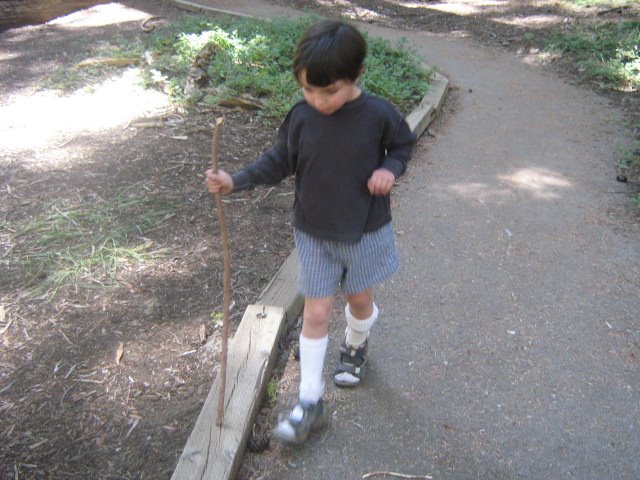
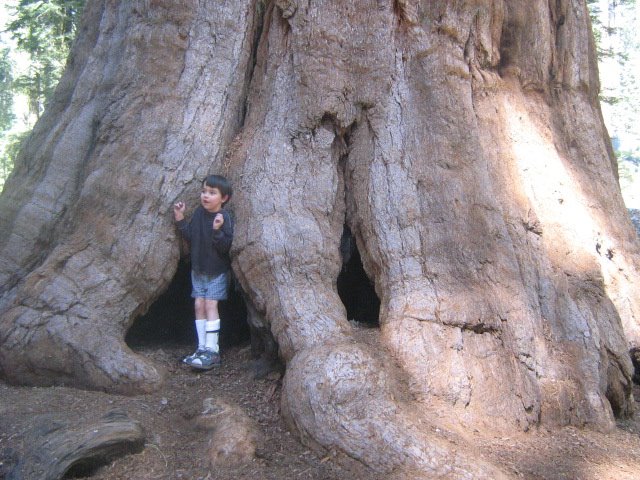
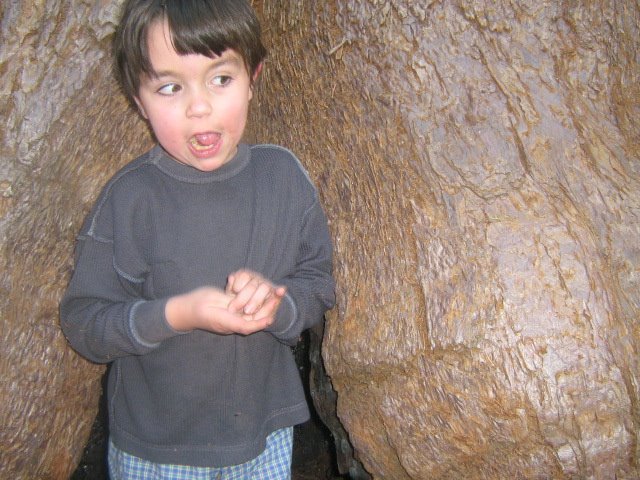
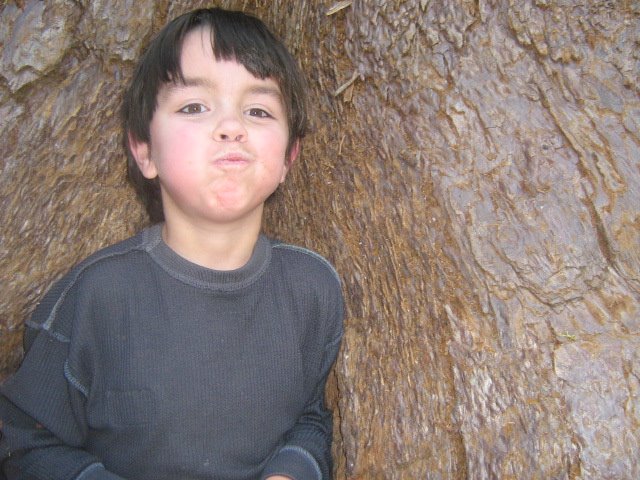
We are fortunate enough to have a little known Giant Sequoia grove only a few miles away from our house. My husband took the kids there a couple of weeks ago. These pictures of our own little survivor that my daughter took are so cute, I wanted to share them as he closes in on the 7th anniversary of his liver transplant. I do not know how she got him to make those faces : )


Math and Real Life

I took the spring and summer completely off math hoping to get a better idea of how to do Living Math (HT JoVE at Tricotomania). I wanted to look at how math appeared in our daily lives. So I’m just going to list a few random things that happened:

Paddy counting skittles with one to one correspondence with his fingers. “I have 4 skittles” (holding up four fingers). “Now I have 3.” Etc. Funny how little ones just seem to pick that up by osmosis. I have never, never sat down to teach him this.
Kieron doing cross-corollations between his spending money and what he wants on Ebay. He discovered ebay late this summer and has been actually pretty resourceful and creative in choosing things he wants for the best price. One example — he bought arms and legs for one of his bionicles that had lost those essential appendages. This week he bought a slingshot after hearing his dad talking about them. He has been browsing for wooden swords, recently, but has to wait and save his spare change until he can afford one. Sometimes this motivates him to ask me for jobs so he can get extra money.

Sean asked me how to do averages today. He wants them for his fantasy football league stats, which is how Brendan really mastered percentiles and statistics. Sean did averages back in sixth grade but now he really wants to understand them.

Aidan is still working on one-to-one correspondence with numbers but he is up to counting four. A friend said that she taught counting with Skittles. You could eat as many as you could count. That sounds like it might get him over this little hurdle. If it wasn’t for that gap, and his fine motor difficulties, he would be basically close to first grade level.

Now for the textbook-y math:

Sean is on Key to Algebra. I am going to bring Key to Geometry back in as a supplement/substitute. If he can finish these mostly by the end of the year he will be on a pretty good track. I am going to try to find some creative, not too boring ways to bring in a basic arithmetic review.

This is what I’ve always done with Kieron — used a scope and sequence as a kind of spine and just pulled in different books and resources as needed rather than working strictly from one. A few pages of Miquon here, MCP Math there, Ray’s for mental calculations and story problems, and then of course drill sheets from the internet, some math games both electronic and non-electronic, and various manipulatives. It has been pretty sporadic so this year I want to try to get an idea of where he actually is, since he is 10.

I guess this isn’t totally unschooling but it seems to fit the way we do things. Kieron can add together shipping plus basic price without a problem, and Sean can do some calculations faster than I can.

One thing I am intending to do, whether by blogging or privately, is to keep a sort of journal of their progress in different areas and any issues that come up. In my structured years I found it so disheartening to work from checklists and schedules. Even when I got to check off a lot of page numbers it didn’t seem to have much meaning, for any of us. So this year it would be nice to have some annotations to go along with it, that I can look back at from the point of view of a unique experience, not just another kid working through a math book.

Tuesday, September 05, 2006

Un-Planning

I have been trying to plan for this year and figure out the best way to do my record-keeping. Every year I seem to do it differently. For a few years I tried hard to standardize it, but realized that some variety is OK and even fits my style of doing things. However, I do think I need to be more consistent about how I file things just so I can find them again. I hate both ways of wasting time — ONE, micro-classifying things so it’s an incredible burden to get them stored in the first place –TWO, jumbling them into little corners all over the place so I have to ransack the house to find something I need.

The operative principle here is KISS. If I get the big picture going allright, the details usually follow more easily than when I start from the bottom up.

I like the way My Thoughtful Spot plans according to:

First Priority

Second Priority

Third Priority

and of course, BOoklist

Here’s some more on planning from Cajun Cay (linked on my other blog, but word-press has categories so I want to have it mostly in one place.

Here some internet support for SOL which might be useful. It is mostly computer games and resources built around standards. I was thinking that it might provide a loose framework or supplement to some of the other things we are doing.

Monday, September 04, 2006

Motivation #1

Maureen asked for details on one of the Seven Habits I mentioned in response to hers--

5. Habit of fostering motivation and the responsible use of the will by balancing freedom and discipline.
I have been thinking about it, probably a long time after she forgot it! The more I think, the more mysterious the process of motivation seems. Perhaps that is a good thing.

I started to blog a reply, and got bogged down. Now I'm thinking that it's too big a subject to address in one post. Anyway, I decided to just keep thinking about it, and when I come up with something that seems to apply to the question, to write it down.

What about all of you? What have you found out about motivation in the homeschool? What do you think of when you think of "motivation"? Any tips, or strategies or theories?

Here's an earlier post to do with motivation:
Public School vs Unschooling where I wrote:
It's a tricky question: Will kids learn by being forced to? Will they learn if they are left to do it freely? People seem to divide in two camps when faced with this question. I don't think either extreme represents reality accurately, but I have to say I think the "unschooling" camp has a bead on a more human truth than the "they won't do it unless they have to" extreme.
George Weigel wrote in Letters to a Young Catholic of the concept of "freedom for excellence".
"According to one of his most eminent contemporary interpreters, the Belgian Dominican Servais Pinckaers, Aquinas' subtle and complex thinking about freedom is best captured in the phrase, freedom for excellence. Freedom, for St. Thomas, is a means to human excellence, to human happiness, to the fulfillment of human destiny. Freedom is the capacity to choose wisely and to act well as a matter of habit — or, to use the old-fashioned term, as an outgrowth of virtue. Freedom is the means by which, exercising both our reason and our will, we act on the natural longing for truth, for goodness, and for happiness that is built into us as human beings. Freedom is something that grows in us, and the habit of living freedom wisely must be developed through education, which among many other things involves the experience of emulating others who live wisely and well."
A Better Concept of Freedom
This might seem like a tangent, but I want to get some of the groundwork laid.

The Online Etymology Dictionary traces the word motivation as follows:
motivate
1885, "to stimulate toward action," from motive (q.v.), perhaps modeled on Fr. motiver or Ger. motivieren. Motivation first recorded 1873; the psychological sense of "inner or social stimulus for an action" is from 1904.
motive
1362, "something brought forward," from O.Fr. motif (n.), from motif (fem. motive), adj., "moving," from M.L. motivus "moving, impelling," from L. motus, pp. of movere "to move" (see move). Meaning "that which inwardly moves a person to behave a certain way" is from c.1412.
Looking at that fairly recent definition, tracing from the earlier days when the science of psychology was in its infancy, I am thinking that it is rather value-neutral. The word "motivation" is a bit ambiguous. Do we mean "motivation to do what I want the child to do?" "Motivation to be active, it matters not how" or "Motivation to do what is right?" No doubt the latter, for many of us; for me, certainly; you can see I originally conjoined it with "the responsible use of the will"

However, the ambiguity points out that in that way, "motivation" is a transitive word. It needs an object, like CS Lewis pointed out about the word "progress". "Progress" towards what? It's important to know what you're aiming for, in some sense, to know whether you are hitting or missing. "Motivation" towards acting rightly; but in learning and education as in life there is a strong subjective element in what is "right". I can say with fair safety that even if my 7 children have access to exactly the same education, they will all end up in different states of life, and some of the difference will lie in that mystery of what motivates, moves, inspires them.

I meant this to be more practical ideas and instead it is amateur philosophizing. Next time.....! However, I did want to get those central thoughts in place, obvious though they may be:

When thinking of motivation, we have to think of what the motivation is for. What is essential for every person and what is just convenience, or convention. Perhaps I shouldn't say "just" so dismissively. Convenience and custom are fine things but they ought to be rooted to bigger purposes.
Motivation will be personal and individual, just like your children are, and for that reason a bit of a mystery.
Freedom and discipline aren't a dichotomy; rightly understood, they complement each other, though freedom is the more fundamental of the two. But like motivation, both seem to require an object. Freedom to or for WHAT? Discipline to what purpose? I don't say we have to have it all settled in our minds before we start educating -- a process that begins before birth, no doubt -- but I do say that reflecting and pondering on these things occasionally will bear fruit and prevent some of the errors in thinking that might block motivation.

Young Ones and Imagination

Paddy, who is going to be four this December, is really going through a development in his imagination. He comes up to me, “Mama, I’m a kitty. You’re the mama kitty. Miaow!” Being a kitty seems to be a recurrent activity, rounding out his traditional “fighting” games where he takes two Guys (who might be anything in the world, from fruit snacks to legos to sticks) and makes them fight with each other.

The other day, while I was washing the dishes, I found myself dialoguing with him the whole Three Little Kittens story. I was the mama ” What? Washed your mittens, you darling kittens” and he was the three little ones. “Purr, purr, purr, we may have some pie.” I think I will count this as his first narration, and a creative one, too.

He tells us about his imaginary friends — he has four of them, but one seems to be his more constant playmate. This friend is called “Betty” but in spite of the name, is a boy. They swordfight together, and share the same food. His other friends are called Shadow, Nova, and Klunkel.

Here is a short article about the Power of Pretend Play and its aid to development.

Here’s a blogpost about imaginary play.

A slight negative article about imaginary friends and a more positive one.

If you’ve read either Anne of Green Gables or Calvin and Hobbes, you can see that it seems to be of the nature of smart, verbal, perhaps slightly lonely children to have an imaginary friend.

I think possibly Paddy is a bit lonely. He is certainly surrounded by people all the time, and he does get to see peers regularly, but he is my most extroverted child. Aidan is developmentally close to him in age, but Aidan’s play patterns are less social than Paddy’s, and the two don’t seem to play together very often.

Aidan has advanced in his imaginary play, too, though. Yesterday he dressed his sleeping bag roll in his favorite shirt and spent a couple of hours carrying it around and talking to it. He weighed it on our scale, etc. His pretend play is very concrete. Partly I think because of his domestic, practical temperament — he is much more involved in the day to day nitty-gritty of life than any of my other kids. Also partly because of his difficulties with abstract thinking and conceptualizing. An example of this came up in his first speech therapy of the new school year, last week. He has identified features on a face for several years, and gave himself an intensive course in memorizing features on his Pikachu pillow, when he was about four. He’d lovingly sing out each feature “Pika’s nose; Pika’s mouth; Pika’s eyes” every night when he was going to sleep.

Yet, faced with a blank oval and asked to draw eyes and so on, he was random. We will work on that and hopefully it will develop his observational or generalization abilities, not just be an isolated splinter skill.

Both Aidan and Paddy are at the stage where they want to hear simple stories and rhymes over and over again, and can recite or “read” books with great delight or in Paddy’s case, dramatize them. Aidan proudly read me several simple board books the other day. He’s not reading, but it is an important pre-reading milestone. Growing without Schooling has a lot of anecdotes about small children moving from the memorized book stage to actually sounding out. Aidan may need a little help, but he is definitely moving along the right track.

Sunday, September 03, 2006

More on Planning

Cay at Cajun Cottage has a very comprehensive post on her homeschool plans for the year.

I like what she says as a preface to the details:

Caution: As thick and compressed as these lesson plans look here they are really just hanging on a thread allowed to swing and float and twirl as our fancies, our personal schedules, and our home life decides that they may.

Saturday, September 02, 2006

Therapy and Homeschool

Castle of the Immaculate has some good tips on Therapist Strategies.

I have been keeping a notebook on and off since Aidan’s infancy. While he was in the hospital I would note lab results and medication schedules. When he went home I kept an informal flow chart — temps, how he acted, feedings — which I reactivate whenever he’s going through a medical issue. It’s VERY useful when calling a doctor to have symptoms, concrete numbers, time frames.

I also kept a food log when I was trying to get him to eat more by mouth.

Now that his medical issues are in abeyance for the time being, and he is formally at school age, I have been devoting the record-keeping energy to writing down how his therapy sessions go and writing out the home exercises and activities suggested by the therapists.

What I HAVEN’T done yet is plan out specific times of the day and a routine for doing the exercises. Presently it’s a matter of tucking them into pockets of the day, which means, sometimes some of them slip.

A SUGGESTION: I have just started taking photos of Aidan’s clinic visits and therapy sessions. I try to get a photo of him doing the various activities. That helps me decipher my scribbled notes (what did I mean by “pull broom up behind back??”) and also hopefully provides a running record of his development. Anyway, so far it seems easy and effective and no real negatives. It might be a “Captain Obvious” idea to some but it hadn’t occured to me before to do this, so maybe it will be new to someone else.

Unschooling Voices #3 is Up

It can be found at A Day in Our Lives.

Friday, September 01, 2006

"Pegs"

I realize I keep talking about “pegs” and while the concept is familiar to some, it might be a new term to others.

Here’s an old post where I talked about how I use Pegs in Planning and Scheduling.

Leonie originated the term, or at least was the one who originally brought the concept to me. Here’s a short post from her.

Here’s an extensive post by Melissa Wiley on how she uses the concept in her homeschool.

And a couple more:

Mary Vitamin

Another old post from me: JOy and Pain

Pegs for Vocabulary from Sprittibee

Pegs to Hang Learning On — Unit STudies by Elizabeth Foss

Booklists

Here are some sites I use to compile books for my middle scholars:

My favorite approach is the clusters arranged loosely by themes, like Elizabeth’s reallearning booklist above. I helped her choose the books and put them in some sort of order, especially in the higher grades on the list.

When I used the list with my second son, then in sixth grade, I chose one book from the month to read aloud. The others were for independent reading, depending on his interest level. Then I would choose a “context” book — either a saint’s life or some other non-fiction book — to read alongside the fiction one. We had a spine reference book — the Kingfisher Encyclopedia of History — and he usually did a map and kept a timeline.

Sometimes I’d think of art projects, or language arts standards of learning, or poems to memorize along with the theme. But sometimes we just read the book and talked. I had an overriding theme for the year, something sufficiently vague like “the importance of the individual person in pivotal historical moments”.
IT was so much fun and I still refer to those books when we’re studying something now — it gave him some “pegs” to hang other things on in future.