I have been thinking about "good stress". There is such a thing, and what constitutes "good stress" will depend very much on the individual and his reaction. This applies to children as well. Sometimes called "eustress" to distinguish it from "distress", good stress is a taxing of mind, body or spirit that leads to growth and a sense of self-worth and fulfillment.
So in light of that, how do we challenge our children appropriately and guide them to react to stress in a positive way?
The Greek prefix "eu" means well or good. Stress is a Latin word -- the closest Greek equivalent looks like anagke. Some other related words are Tolkien's eucatastrophe (meaning the happy reversal that comes at the end of a redemptive story) and eudaimonia (Aristotle's word for happiness, which connotes something like a good spirit or good fate).
Charlotte Mason talks about the infant kicking his feet for sheer joy; but at the same time, he is developing the very muscles that will later help him crawl and walk and run.
Sports can be a "good stress" depending on the child. I remember when my younger two boys were in T-ball. I saw one child being literally dragged into the field by his mother. He was screaming up a storm. Of course, no one could force him to actually play, and he ended up at the "bench" (really, for these little ones, a blanket spread upon the grass). I was the supervisor of the bench, to keep the bored youngsters from kicking each other and getting into the sort of mischief that little kids get into when they have nothing to do. I looked into this little boy's eyes and saw that he had shut off. His eyes were like the sky -- empty and bright. I felt as if I'd seen a little tiny creature curled up inside his soul, afraid of everything and unable to uncurl. So the exterior was all unresponsive amusement, protecting the stressed spirit inside. He was hard to supervise. I could totally relate to his young mother who probably thought she was teaching him character by forcing him to play, and perhaps indirectly she was helping his character formation by her intense sincerity. But in the moment, this boy was a distressed creature incapable of learning anything.
This, I would say, is not good stress, and I look for the kind of things that will encourage my children to expand, not contract into a miserable psychic ball. I think this differs for everyone. I know that the level of stress that feels like a positive charge to a choleric or sanguine child was enough to push me to the end of my coping devices when I was a small melancholic child.
Sometimes, though, a child needs a bit of exhorting or a nudge of some sort to reach his positive stretching point. This is probably my weakest point as a parent; I get too easily immersed in the anxiety of the child; it reverberates as my own anxiety. I think I probably arrange life too much to suit my own stress tolerance level. So definitely, there is a balance.

Tuesday, October 31, 2006
Monday, October 23, 2006
Travelling Again
This has been a mileage month. First up to Oregon, then home, then back up north again to pick up my teenage daughter and be at our friends’ birthday party. Now I’m off again to visit my parents up in Alaska.
So that’s why this blog has been so quiet lately….. I hope to do better after I get back.
I put a few pictures here.


Sunday, October 22, 2006
October: Hail, Home Fires, and Haircuts

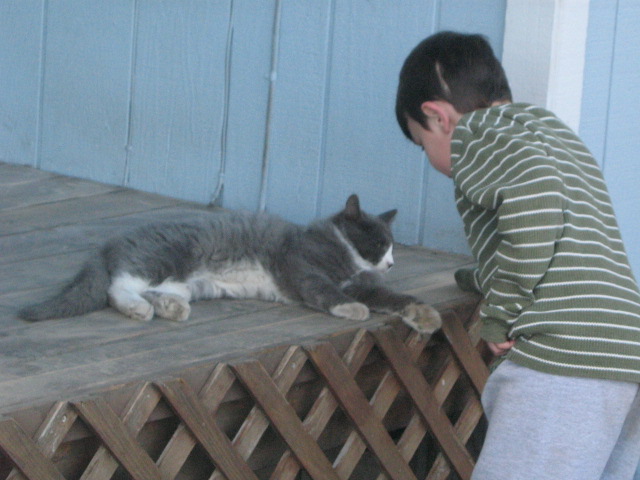
We just got back from travelling and I am travelling up to Alaska tomorrow, so here's a few pics to make up for the lack of posts! Back next week in time for Hallowe'en.


Wednesday, October 18, 2006
More on Fantasy and Reality
Genevieve at The Good Within compiled a list of links discussing Montessori on "Fantasy and Reality", including the conversation Kim of Starry Sky Ranch and I had a while back. For some reason blogger won't let me access the permalink to the individual post, so I'm quoting her entire post -- for anyone who wants to read more on this topic.
Genevieve's blog post:
Genevieve's blog post:
Fantasy and reality
This is a subject matter which has been on my mind lately but to which I have yet to come to a conclusion. But I figured I'll link some good articles/opinions on the subject matter.
Kim talks about it here and here.
Willa also mentions it here, here, here and here.
Montessori mom also has something to comment on the subject here, here and here
There is an old conversation on this at 4 real here and here
Tuesday, October 17, 2006
Age quod Agis -- Logistics in the Homeschool
Father John Hardon SJ has written about the importance of an "agenda" in the Christian life. The etymology of "agenda" is similar to the Latin in an old motto shared by a friend of mine: "Age quod agis" -- "Do what you are doing." In order to accomplish this, Father Hardon recommends planning out one's day in order to make sure that necessary things get done. Part of this task is to make some time to reflect upon the day in an evening examen. Though he was talking about the spiritual life in particular, the ordinary life overlaps and is affected by the spiritual life, so I think his advice applies to our lives as homeschooling moms as well. It is somewhat like St Maximilian Kolbe's motto: "Preparation; Action; Conclusion."
A few years ago I found myself homeschooling two high schoolers, a middle schooler, two elementary graders plus caring for two medically complex little ones. I am not a naturally organized person, but that situation motivated me to develop some logistical strategies quickly. I wanted to share some of them -- few are original; most were adapted from the advice of friends and mentors.
During a high risk pregnancy and with a newborn who needed lots of medical intervention, my first homeschooling priority was to have a way to keep the kids on track even if I had to be away or couldn't do much active teaching or planning.
So I developed a simple checklist for each student. It listed various subjects with simple instructions like: Do the next lesson; read the next chapter and take notes; do the next section of the syllabus; or sometimes, work with Mom. These were streamlined forms of the assignment sheets I'd given them in other years. They were more general and all-purpose so I could print out basically the same checklist every week and minimize preparation time . The kids understood that on "Plan B" days, when I was gone or caring for a sick little one, they could skip the "work with Mom" assignments and just do the ones they could do independently.
We also had a chore checklist on the refrigerator. Every child had their housework and their mealtime chores, and there was a meal rotation so if necessary, someone besides me could take over the cooking. A "Chores" section was included on their school checklist as a reminder for this, and also a "personal hygiene" reminder for the younger ones to remind them to make their bed, brush their teeth, tidy their room and so on.
The children acquired the habit of putting their completed schoolwork in a pile on my worktable along with their filled-in checklistswhen they were finished for the day. That way, I could conveniently check through their work and verify their checklists whenever I had some spare time. Sometimes if necessary I would call them back to go over a serious problem, but most of the time feedback could wait till the next day.
I scheduled times to work with each of the kids individually. It did not happen every day, but most days we could fit in at least a few moments. The elementary school students needed the most teaching time, so they usually worked with me for two or three hours in the morning. Usually I could alternate between them -- working with one to introduce a new concept or task, while the other one read or worked independently or kept the little ones busy.
By late morning the two younger ones would usually be done with the subjects that needed my help. Then I would work with the three older ones, who were in middle and high school. Two of them preferred to work mostly independently. So I would meet with them only once or twice a week, usually to discuss a reading or go over a paper. But one of my older ones really benefited from a daily meeting to talk, look over work and give him a head start on the next day's subjects. So I scheduled a time just before lunch for this. My goal was to do most of the intensive coaching in the morning and leave the afternoons for more open-ended discussion, for grading, for planning and for housework. I also scheduled two times when we all met and I taught several at once -- we did Latin this way and we also gathered for a free writing period together just before lunch. Everyone wrote for 20 minutes, even me; even the toddler scribbled in his high chair with crayons or pencils. This turned out to be a nice time in the day to slow down a bit, and it made a huge difference in their attitude towards writing.
I bought a large binder and an accordion file for each child. These were color-coded -- each child had a chosen color for his binder, folders and notebooks so I could pick them out at a glance. The syllabus, checklists and various handouts and study guides went in the binder. The accordion file made it simple to organize loose, completed work by subject. When I had time I would file the loose work more permanently in the binder. My oldest filed and kept track of his own work but I did the record-keeping for the younger ones. I updated these regularly on weekends.
Because we had a lot of medical things going on at the time with the preschool child and baby, our schedule included two lighter academic days per week. On these days, there were no "work with Mom" subjects -- the children only did the things they could do independently. The first grader often had these days off, though I tried to keep a "learning box" with some simple activities he could choose to do on his own. I tried to schedule medical appointments for these two lighter days; also any extra-curricular activities and visits to the library. We also did our major housekeeping on these days, as a team. If they were caught up on their work, they could have some time watching a movie or playing computer games. This gave me a bit of extra time to catch up on enjoying the little ones or catching up on the things that needed catching up on. There was always something!
We tried to keep evenings a bit looser so we could spend time as a family and so the little ones had some open time to be around their parents and siblings. As mentioned by Father Hardon, I would try to spend a few minutes before bedtime noting down the "agenda" for the next day. Every Sunday evening, I would fill out a weekly "at a glance" schedule which went on the refrigerator so the kids and my husband could see what days were taken up by appointments and other commitments.
This system did not always flow perfectly, of course. It was strenuous, and sometimes I couldn't keep up. But it kept us from falling way behind. And as a result my oldest was able to graduate with an excellent GPA, a good SAT score and entrance to a good Catholic college.
Now my two oldest children have graduated. My four school-age kids are not so time-intensive, and the medical situation is much more stable. So my methods of operating don't have to be so rigorous. I still use basically the same system, but I have more time to work with the kids more informally and individually. I can be more of a coach and mentor and less of an administrator. We probably waste a little more time, but the leisure gives us a bit more time to build up family traditions and habits of conversation, and include more games and fun. There are benefits and drawbacks to both types of systems.
From this I have learned that organization looks different in different seasons. Organization is a servant, not a master. Orderliness is a good thing, but it works best when suited to the need of the situation and also to the comfort level of the people using it. That is where Father Hardon's other advice -- discern, and seek the will of God continually -- comes in. Pray and build up the methods that best suit the season your family is in. Age quod agis.
A few years ago I found myself homeschooling two high schoolers, a middle schooler, two elementary graders plus caring for two medically complex little ones. I am not a naturally organized person, but that situation motivated me to develop some logistical strategies quickly. I wanted to share some of them -- few are original; most were adapted from the advice of friends and mentors.
During a high risk pregnancy and with a newborn who needed lots of medical intervention, my first homeschooling priority was to have a way to keep the kids on track even if I had to be away or couldn't do much active teaching or planning.
So I developed a simple checklist for each student. It listed various subjects with simple instructions like: Do the next lesson; read the next chapter and take notes; do the next section of the syllabus; or sometimes, work with Mom. These were streamlined forms of the assignment sheets I'd given them in other years. They were more general and all-purpose so I could print out basically the same checklist every week and minimize preparation time . The kids understood that on "Plan B" days, when I was gone or caring for a sick little one, they could skip the "work with Mom" assignments and just do the ones they could do independently.
We also had a chore checklist on the refrigerator. Every child had their housework and their mealtime chores, and there was a meal rotation so if necessary, someone besides me could take over the cooking. A "Chores" section was included on their school checklist as a reminder for this, and also a "personal hygiene" reminder for the younger ones to remind them to make their bed, brush their teeth, tidy their room and so on.
The children acquired the habit of putting their completed schoolwork in a pile on my worktable along with their filled-in checklistswhen they were finished for the day. That way, I could conveniently check through their work and verify their checklists whenever I had some spare time. Sometimes if necessary I would call them back to go over a serious problem, but most of the time feedback could wait till the next day.
I scheduled times to work with each of the kids individually. It did not happen every day, but most days we could fit in at least a few moments. The elementary school students needed the most teaching time, so they usually worked with me for two or three hours in the morning. Usually I could alternate between them -- working with one to introduce a new concept or task, while the other one read or worked independently or kept the little ones busy.
By late morning the two younger ones would usually be done with the subjects that needed my help. Then I would work with the three older ones, who were in middle and high school. Two of them preferred to work mostly independently. So I would meet with them only once or twice a week, usually to discuss a reading or go over a paper. But one of my older ones really benefited from a daily meeting to talk, look over work and give him a head start on the next day's subjects. So I scheduled a time just before lunch for this. My goal was to do most of the intensive coaching in the morning and leave the afternoons for more open-ended discussion, for grading, for planning and for housework. I also scheduled two times when we all met and I taught several at once -- we did Latin this way and we also gathered for a free writing period together just before lunch. Everyone wrote for 20 minutes, even me; even the toddler scribbled in his high chair with crayons or pencils. This turned out to be a nice time in the day to slow down a bit, and it made a huge difference in their attitude towards writing.
I bought a large binder and an accordion file for each child. These were color-coded -- each child had a chosen color for his binder, folders and notebooks so I could pick them out at a glance. The syllabus, checklists and various handouts and study guides went in the binder. The accordion file made it simple to organize loose, completed work by subject. When I had time I would file the loose work more permanently in the binder. My oldest filed and kept track of his own work but I did the record-keeping for the younger ones. I updated these regularly on weekends.
Because we had a lot of medical things going on at the time with the preschool child and baby, our schedule included two lighter academic days per week. On these days, there were no "work with Mom" subjects -- the children only did the things they could do independently. The first grader often had these days off, though I tried to keep a "learning box" with some simple activities he could choose to do on his own. I tried to schedule medical appointments for these two lighter days; also any extra-curricular activities and visits to the library. We also did our major housekeeping on these days, as a team. If they were caught up on their work, they could have some time watching a movie or playing computer games. This gave me a bit of extra time to catch up on enjoying the little ones or catching up on the things that needed catching up on. There was always something!
We tried to keep evenings a bit looser so we could spend time as a family and so the little ones had some open time to be around their parents and siblings. As mentioned by Father Hardon, I would try to spend a few minutes before bedtime noting down the "agenda" for the next day. Every Sunday evening, I would fill out a weekly "at a glance" schedule which went on the refrigerator so the kids and my husband could see what days were taken up by appointments and other commitments.
This system did not always flow perfectly, of course. It was strenuous, and sometimes I couldn't keep up. But it kept us from falling way behind. And as a result my oldest was able to graduate with an excellent GPA, a good SAT score and entrance to a good Catholic college.
Now my two oldest children have graduated. My four school-age kids are not so time-intensive, and the medical situation is much more stable. So my methods of operating don't have to be so rigorous. I still use basically the same system, but I have more time to work with the kids more informally and individually. I can be more of a coach and mentor and less of an administrator. We probably waste a little more time, but the leisure gives us a bit more time to build up family traditions and habits of conversation, and include more games and fun. There are benefits and drawbacks to both types of systems.
From this I have learned that organization looks different in different seasons. Organization is a servant, not a master. Orderliness is a good thing, but it works best when suited to the need of the situation and also to the comfort level of the people using it. That is where Father Hardon's other advice -- discern, and seek the will of God continually -- comes in. Pray and build up the methods that best suit the season your family is in. Age quod agis.
Monday, October 16, 2006
Rule of Six
at St Athanasius Academy
also see this thread
and this one on Unschooling and Goals
FInally, here's one about Unschooling Pillars
Update: and Michele at Family Centered Life added her own version which I really like.
also see this thread
and this one on Unschooling and Goals
FInally, here's one about Unschooling Pillars
Update: and Michele at Family Centered Life added her own version which I really like.
Sunday, October 15, 2006
Disability -- link
Interesting disability-advocacy site by a Catholic
HT Amy Wellborn
I think I will be checking in on it again in future as Aidan gets older. Some quotes:
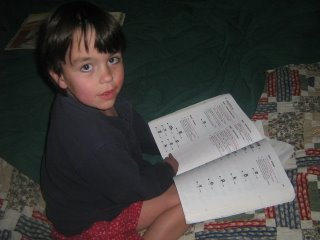
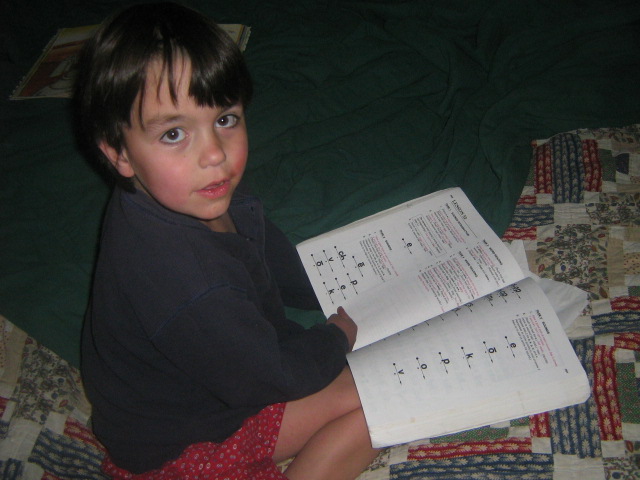
More and more, as Aidan grows older, I am respecting that his disabilities, while not chosen by him or by me, are part of the deal he has been given and the trick is that it's how you play the hand that counts. As he moves into his 8th year of life, I am so often impressed by his ability to engage in things, his hunger for experience and competence, his sense of playfulness with words.
"So early in the mooorning, before the FIX of day," he sang yesterday, smiling at me and emphasizing the key word to show me it was one of his opposite jokes.
That one took me a while to figure out. You can see the whole song here.
Even when I figured out that the lyrics originally called for "break" he still had to explain it to me. "Break -- broke -- FIX." Okay, Aidan, now I get it!
HT Amy Wellborn
I think I will be checking in on it again in future as Aidan gets older. Some quotes:
also this:
"Many people assume that living with cerebral palsy means that I am endlessly confronted by my body's limitations. Actually, this is not my experience. Having cerebral palsy means living a life in which innovation, improvisation, creativity and lateral thinking are essential. In practical terms, it means knowing which cup fits snugly into the sink drain and doesn't tip over when I pour coffee. It means finding the same challenge and enjoyment in finding my balance on an icy sidewalk that my friends find as they master tai-chi. It means being ever-conscious of the number of drinking straws in my possession in the same way that a smoker is always aware of the remaining number of cigarettes. It means paying attention to breathing and articulation, like a jazz singer crafting a phrase. It means bracing my wrist on the table before I grasp a glass of wine in the same way that Emma braces her left hand when she threads a needle. As far as I know, Emma does not long to be a brain surgeon every time the eye of a needle eludes her thread."
"In the quest to figure out what equality means, many of us confuse it with symmetry. The commonly accepted definition of "fair" seems to be "a tidy thwack down the middle of everything." It's as if we believe that equality can be mandated, maintained and meted out by an exacting and humourless accountant. We've decided to take a longer view of equity. We know it isn't about treating people the same, ending up with a carefully balanced sheet at the end of each day. It's about quality of life, negotiation, interdependence and long-term relationships.. We're learning that giving means contributing what you can where you can, without obsessing about what you don't have or can't do. We know that what we get back is often unexpected, generous and complementary. It creates a different kind of climate -- life is less structured and more fun. Imagination, flexibility and humour are a bigger part of our lives -- things few of us feel we have enough of."
More and more, as Aidan grows older, I am respecting that his disabilities, while not chosen by him or by me, are part of the deal he has been given and the trick is that it's how you play the hand that counts. As he moves into his 8th year of life, I am so often impressed by his ability to engage in things, his hunger for experience and competence, his sense of playfulness with words.
"So early in the mooorning, before the FIX of day," he sang yesterday, smiling at me and emphasizing the key word to show me it was one of his opposite jokes.
That one took me a while to figure out. You can see the whole song here.
Even when I figured out that the lyrics originally called for "break" he still had to explain it to me. "Break -- broke -- FIX." Okay, Aidan, now I get it!
Saturday, October 14, 2006
Back from Oregon, with Books
We got back from our trip last Wednesday but the next day I woke up sick. It only happens about once a year — where I am too sick to get out of bed — but this was one of those times. Kevin went into high gear and picked up Frodo (the Aussie shepherd) from the kennel in town, did some shopping, and made a great meal — grilled seasoned tri-tip, sauteed mushrooms with garlic and rum and basil, and a salad. He had bought cream puffs for dessert. So it was sort of my birthday dinner a week late. He also tidied up the house and put away the sleeping bags. Bless him.
While at Oregon I found a set of little tiny hardcovers — the Original Pooh Treasury series — they are individual Winnie the Pooh stories, told in the original language with the original pictures — unfortunately there is no image available at Amazon. They are perfectly charming and I got 5 of them for 12 cents each. They are just a leetle beyond Paddy’s comfortable listening level but he loves to stack them and look at them and he did listen to them yesterday. But Kieron, 10, found them the most congenial — laughed at the absurd parts and really appreciated the humor. Come to think of it, he’s just the kind of kid who could relate to these stories. For some reason I’ve never actually read Milne to any of my kids — odd because I liked it as a child. But it seemed that by the time they were old enough to listen and appreciate, they were too old to want to hear stories about bears and rabbits. Anyway, these little books may help me cultivate an interest in the Hundred Acre Wood for my three youngest at any rate — I’d hate to have raised 7 children and never introduce them to Milne beyond the Disney cartoons, which aren’t the same thing at all.
I got Brendan his own set of Lord of the Rings paperbacks too…. we wore out the original hardcover volumes we had; then Clare got a paperback set for her birthday a few years back — but now Den has his own.
Clare found some collectible hardcover editions of Father Brown, Jane Austen and Charlotte Bronte for herself. And Kieron spent his allowance on — strangely enough — a Star Wars math program — in FRENCH. He actually won it yesterday. Has been trying to puzzle out the French on the back of the package.
Kevin and I bought ourselves some science fiction books… fun. We shared this interest in common during our university years and before we met, in our high school years, but neither of us do much fiction reading any more so it was fun to go on a fantasy/sci fi marathon while travelling for 12 hours each way. Also, Kevin downloaded a bunch of audio books onto an Ipod so we got to listen to Byzantium history and also Treasure Island en route — also Father Brown mysteries and several episodes of Dragnet and Jack Benny. And thousands of songs from his CD collection…. all the way from Glen Miller to Neil Young to the Clash and Gregorian Chants. Talk about scope and sequence.
Aidan discovered one of the older boys’ old Handwriting without Tears books and has been spending a few minutes every day writing in it by choice. He has an excellent crayon grip. It makes me realize that a little tiny bit of intervention can go a long way. Brendan never really got an easy pen grip because I left him to himself. Though now his grip IS functional and he has nice writing, it didn’t come easily to him till his teen years. I have to ponder on that a bit. I am so non-interventionist sometimes that I am afraid I leave things TOO much to themselves in some ways. For instance, none of them were ever taught by me to tie their shoes. Some figured it out on their own and others learned from siblings, and Brendan still stuffs his laces under the tongues of his shoes. In other ways I probably expect too much, usually in abstract reasoning. Probably basically comes from being rather uncomfortable with practical, sensory things. I need to be aware of that.
Now Aidan and Paddy are playing with the Handwriting Without Tears Magnadoodle (mentioned here in a Learning to Write post at Lilting House — HT The Good Within)
Aidan wants me to make some breakfast so I guess I’d better go.
Wednesday, October 04, 2006
Progress
Sean
– near the end of book 5 Key to Algebra
– started reading Story of the Church
–read chapter 4 of Our Life in the Church
– continues Latin vocabulary.
– rereading Lord of the Ring trilogy, Outlaws of Ravenhurst and Father Finn books.
Kieron
– on chapter 8 in Saxon 65
– also doing pages from Developmental Math and math games online
– starting to read Bible History
– chapter 4 in Credo I Believe
– continues Latin vocabulary
– read some of Usborne’s Time Travellers
– fun reading — Narnia Chronicles, Redwall, and we finished the LIttle Lame Prince
–he is working on his story — has some artwork on the computer.
They both have gotten into the SET game.
We are going on a trip for the next week and so I’m bringing the math and a couple of other books so they can do some minimal work.
Sunday, October 01, 2006
Daily Literature
This is neat — you can sign up to receive daily installments of book at your email address at Daily Lit. I have signed up for “Famous Poems Every Child Should Know.”
Subscribe to:
Posts (Atom)