Monday, March 31, 2008

Thinking about Unschooling

First of all, I think there are many successful ways to provide a child with an education.

Chesterton says:

Of course, the main fact about education is that there is no such thing. It does not exist, as theology or soldiering exist. Theology is a word like geology, soldiering is a word like soldering; these sciences may be healthy or no as hobbies; but they deal with stone and kettles, with definite things. But education is not a word like geology or kettles. Education is a word like "transmission" or "inheritance"; it is not an object, but a method. It must mean the conveying of certain facts, views or qualities, to the last baby born. They might be the most trivial facts or the most preposterous views or the most offensive qualities; but if they are handed on from one generation to another they are education. Education is not a thing like theology, it is not an inferior or superior thing; it is not a thing in the same category of terms. Theology and education are to each other like a love-letter to the General Post Office. Mr. Fagin was quite as educational as Dr. Strong; in practice probably more educational. It is giving something--perhaps poison. Education is tradition, and tradition (as its name implies) can be treason.
An education is whether consciously or not shaped by what the educator thinks is important enough to transmit and the methods used for the transmission. The way I think about it, the more thoughtful and humane the choices are, the better chance there is that the results will be good.

Furthermore, in the homeschool, education can and often is, validly, a seasonal thing. That doesn't mean necessarily snowmen in January and beaches in July -- it means that homeschooling can shift, ebb and flow. Melissa's Tidal Learners analogy is good here. The dynamics are subtle and like life choices, one may not be "superior" to another. It is surely noble and valuable to be a transplant surgeon, say, but surely we don't need 200 million of them? Isn't there a niche for computer game designers, monks, chefs, philosophy professors? Perhaps there doesn't need to be a training school for pickpockets, and most of those who read my blog would probably agree there is no need for a school system that aims to achieve uniformity and unthinking compliance. I wish that a large percentage of the bureaucratic middlemen in the school system would find something more productive to do.

My guess is that in the best of all possible worlds, there would be diversity, not uniformity, in educational "styles". And this is how I finally decided to run my homeschool, because I was really pounding my head into the wall trying to find a perfect "system" and pour our homeschool into it like a mold. Ugh, what terrible mixed metaphors, but maybe they express the state I get myself into sometimes ;-). Anyway, I realized we didn't seem to fit perfectly into any system.

Even radical unschooling. That was one that I chased like St Elmo's Fire. It seemed the most directly Socratic in method to me; it still does. It seems more like Christ and His disciples than any other system. I still dream about opening my eyes and suddenly seeing how it all hangs together. I can't do it someone else's way, though. I wrote about parenting that it was an expression of love and therefore personalistic, unique, irrepressible. I see homeschooling as an extension of parenting (indeed, as the Catholic Church says, I see ALL educational choices, whether public school or parochial school or homeschool, as an extension of parenting). As you see, I see the family as a kiln where philosophy is heated and refined -- "philo" meaning love and "sophy" meaning wisdom. Like Michele, I believe in Family Centered Learning.

Sunday, March 30, 2008

parenting as a creative art

Nothing survives
But the way we live our lives

Jackson Browne, Daddy's Tune


Success or failure in life does not depend on these (external circumstances or natural gifts), but human life, as we said, needs these as mere additions, while virtuous activities or their opposites are what constitute happiness or the reverse.

Aristotle Nichomachean Ethics


..... let it be presupposed that every good Christian is to be more ready to save his neighbor’s proposition than to condemn it. If he cannot save it, let him inquire how he means it; and if he means it badly, let him correct him with charity. If that is not enough, let him seek all the suitable means to bring him to mean it well, and save himself.

St Ignatius, Spiritual Exercises


Melissa has a Respectful Parenting post up and don't forget to check the comments box.

Whenever I start thinking about parenting, I always think of my Mom's story about going to a parenting workshop -- I think it was one of the Ginott-inspired ones-- back in the 70's. When she came home and tried to use non-coercive judgment-free language "Apple cores don't belong on the bed..." my little brother shouted in horror, "Don't talk like that!" He wanted his old mom back.

I think the lesson wasn't that these skills were useless, but that they can't stand alone and they may take some time and attention to incorporate into your daily life. Most of the truly valuable parenting "skills" are attitude changes. You can see that for yourself if you think about a few of your best-ever moments of parenting. You probably weren't "using a strategy" in isolation. You were probably in a confident, loving mode and everything seemed simple.

(And when my mom told me this story about her experience, she was being an awesome parent, if you can see that. She was reflecting on her own experience and teaching me something she had learned without in any way imposing her own opinion on me -- merely inviting me to participate in her own reflections and perhaps add mine. )

I woke up thinking about what makes good parenting a couple of days ago and I immediately thought of my husband. Aidan our sixth child was in the hospital for months after birth, before and after his liver transplant. A couple of things stand out in my mind:

Once was a bit after his liver transplant, when he was four months old. Aidan was out of the PICU and on the regular pediatric ward, but he was still in a room near the nurses station with a monitoring screen and all kinds of hook-ups measuring his heartrate, oxygenation, and so on. We couldn't really lift him out of bed much because his transplant incision was still painful and he had so many hook-ups. He was on a constant feeding drip and if they raised the rate of infusion above something like half an ounce per hour he would throw everything up.

My husband and I took turns staying with him while the other would take care of the rest of our five children. I usually took the night shift because I could sleep easily in a sleep chair with lights and beeps and Kevin couldn't.

When I came in one evening for my "shift" the nurse who had been on duty during the day said, "I've never seen a dad like your husband. Every time I look at the monitor screen he is standing by Aidan's crib shaking that little rattle and talking to him and smiling at him. " He did that day after day. Since Aidan couldn't come out and share in his Daddy's world, his Daddy made sure that as much as possible he entered Aidan's circumscribed and uncomfortable world and brought as much happiness and color to it as he could.

Another time that comes up is when the nurse practitioner who was the transplant coordinator was explaining the side effects of one of Aidan's post-transplant meds -- that he was growing hair over his body and his eyebrows were like thick bars over his eyes. She was reassuring us that this effect would be temporary as they weaned him off the heavy first course of anti-rejection meds.

Kevin touched Aidan's thin downy shoulder gently and said, "Ah, my little werewolf." His voice was tender and amused.

The transplant coordinator, who became a good friend during this hard time, replied, "Some parents find these things make it difficult to re-bond with their children."

Kevin only shrugged in incomprehension. Little werewolf or not, Aidan was beautiful to him.

These moments are small ones, but I see that exhausted dad stooped over a hospital isolette rattling a rattle and crooning at a tiny frail infant, and I hear that gentle "my little werewolf" every time I think about what parenting is about.

The point here is not to boast about my husband, but rather -- what parenting manual or list of strategies could possibly cover the sorts of things that come up in a parent's and child's life?

The only thing that would cover these things is love, and a commitment to see things through.

Jacques Maritain wrote:

What matters most, and is essential, is the fact that love -- I don't mean any kind of love, I mean love of Charity -- when it takes hold of man, makes the entire subjectivity purer, and consequently, the creative source also purer. As François Mauriac put it, to purify the source is the only way.

A purified source is not,..... a source which is timid or prudent, or with an admixture of chemicals. A purified source springs from the depths of man's substance, and is as wild and irrepressible as any other; but it has no mud. This is the work of self-discipline and the cultivation of moral virtues, but first of all of transforming love.
He is talking about creative art, but then, what is parenting but a creative art?

When you have to choose in a difficult parenting situation, if you choose the most loving way, the way that connects to your child, it's hard to go completely wrong. Purify the source.The job becomes a personal one -- to eliminate all the little things that get in the way of love. You can change things bit by bit, second by second, as Sandra Dodd writes on her site. You aren't giving up your parenting duties, then, but rather cleansing them of mud.

When I am in some sort of parenting knot I usually try to follow St Ignatius's method above.... assume the best, try to communicate (with a younger or less-verbal child, a long string of words isn't always the best way to communicate, as I've found from trial and error -- sometimes a word or sign or smile or touch says a lot more). I think a lot of conflicts get ugly from getting locked in and reacting back and forth, rather than stepping outside of the situation. Stepping outside of this is creative and freeing and adventurous. Melissa wrote:

It’s almost like a game, a challenge I present myself: how can I steer us through this rocky place without losing my cool? I have found myself waking up every day eager for the challenge. I’m dead serious here. This really is big stuff.


In one of my husband's Bruce Springsteen live albums there is a wrenching story about his troubled and angry relationship with his father.... how his father would berate him for coming home late, for his long hair, and how that kept driving him further away, to the point where he was sitting in phone booths shaking with cold because he didn't want to come home in the evenings and face that tirade again. I couldn't find that on Google but I did find the lyrics for his song called My Father's House which ends:.

My father's house shines hard and bright
It stands like a beacon calling me in the night
Calling and calling, so cold and alone
Shining `cross this dark highway where our sins lie unatoned.
To me it seems that "if you win, I lose" escalation mentality leaves this kind of empty, wistful battlefield whereas the "win-win" approach leads to a kind of synergy, as Stephen Covey says. Of course the toddler won't be ready to negotiate mutually beneficial solutions in a magnanimous manner that respects his mother's needs, any more than Aidan could have said "oh, Daddy, I can do without your face for a few moments -- go get a cup of coffee and relax with the newspaper for a bit while I play with my oxygen cannulae". They aren't adults, they are apprentices, "learning all the time", as John Holt said, and dependent upon us in so many ways for example and nurturing.


But if the parents don't model mature, loving ways of interacting, how is the child going to learn? I think some people see the word "love" and think "permissive, weak, mushy". But honestly, it doesn't break down that way, or shouldn't. There is nothing permissive or weak or timid about allying with the child to help him to "become who he is", who he is meant to be. There is nothing permissive or lax about letting go of the non-essentials and focusing on the essence. It is strength, not weakness, to focus on the good things and magnify those. Love is as Maritain said "wild and irrepressible". It is deep and unique and springs out of who you are as a person, like any other creative art. It is generous and loves the truth, as he also says, but then you also have to remember that truth is not a sword to use to cut others down -- it is a light that illumines and makes good things clear and transparent and sparkly. For some reason, it often involves laughter, at least in our household. Laughter (not the mocking kind) frees things up and dissolves barricades.

I realize that this doesn't help much with the classic meltdown at Target (where I for one didn't exactly cover myself in glory in the pre-Easter rush) but here are some things that help me during those times when the situation is at maximum-stress pressure level and my Scottish temper is about to get lost never to be found again:

  • Just breathe. Slow down.
  • Keep it in perspective; it isn't the end of the world, and it might well make a good story later.
  • He isn't (or they aren't) any happier than I am right now.
  • Assume the best.
  • Preserve the relationship as much as possible; at any rate, try not to do something that will cause damage beyond the brief time.
  • Try to learn from what went wrong if anything did and apply it proactively for next time. As with all creative arts, "From failure you learn; from success, not so much.”
  • Breathe again and try to focus on the kid(s) and be their mother.
And for the 99% of the day when things are not at crisis point and you are not having your mothering skills observed and evaluated by many total strangers in an environment which is visually overwhelming to you and your children.....

those days can be like gold, or like clear running water. The more good days, the better. It's easier to survive the hard days if there have been golden, sparkling days that brought you closer together and built multiple layers of affection and trust.

Also, the blogger at In Need of Chocolate compiled a list of books about parenting. I haven't read all the ones she lists, but I wanted to keep track of the list.

The painting is St Joseph the Carpenter by Georges La Tour

I guess that's all I have to say about parenting!

Saturday, March 29, 2008

Introspecting

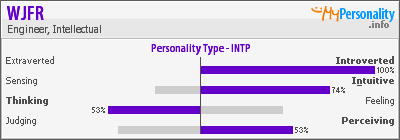
Click to view my Personality Profile page

I got this personality test from Stephanie's blog A Recollected Life.

On this one I came out as an INTP Intellectual/Engineer.
As usual I barely missed being an INFP Dreamer. I usually come out as either one or another in those sorts of tests. I don't see myself as an engineer type because I'm not really very practical so if there were an Intellectual Dreamer category it would probably fit me better.

What personality type are you?

Twaddle

Speaking of "difficulties in the way not belonging to it" what do you think when your developmentally delayed child takes an IQ test at the local school and is given a set of four pictures:

  • a grey shorthaired dog
  • a grey shorthaired cat
  • a tan or yellowish shorthaired cat
  • a calico longhaired cat


When asked which one doesn't belong with the others, he points to the calico cat.

Well, he got it marked wrong on the test, obviously.

BUT:

  1. He is more interested in cats right now than dogs, and this particular calico was a remarkably fine specimen of cat-ness; AND
  2. He sees a longhaired vari-colored creature and opposes it to the other short-haired single-colored creatures. Visually the calico cat stood apart from the others, and that was just a plain fact.

This is what led my husband to remark, "These IQ tests usually only demonstrate that the people who devise the tests aren't very smart."

And the kids that do well on these have learned to choose what they know the adults want. This IS a skill, and it even shows some intellectual ability (the ability to abstract enough to understand what someone else is trying to communicate; I was very good at this and therefore have always been a good test-taker) but this is NOT the intellectual skill the test purports to measure.

Another test involved cartoon fish.

  • This is Ko.
  • This is Neef.
  • (Turn the page to a bunch of fish).
  • Which one is Ko?
  • Which one is Neef?

When we got to the sea-plant called something like Tweekle-plee (honestly, I'm not making this up) Aidan was lost, and so was I, and the school psychologist was too. She apologized for the silliness of the test. I said, "It's OK, I think Aidan is enjoying this." Well, he didn't mind it, but he also didn't really see what it was in aid of, and indeed that was quite a sane reaction.

Again, there is a skill that the test purports to measure (probably something to do with how many random pieces of information you can fit in your short-term memory) and then there is the skill it really measures, which would be something like "the ability to bear patiently and even try to understand something that is pure nonsense."

The child who coined the phrase "I LIKE your guts, Paddy!" and paraphrases the Scarlet Pimpernel when he's trying to run away from me putting his AFO brace on "They chase him here, they chase him there...." is just way above Neef and Tweekle-plee and Co. (excuse me, KO).

Twaddle to me isn't so much what kids like when they have a choice (Aidan loves Pokemon and if the fish test had been about Pokemon, he would have aced it) but what adults impose on kids.

Charlotte Mason gives the telling example of the kindergarten teacher telling the school-children to pretend they are trees, and wave their arms like little branches. But left to themselves, children will play at being Ulysses, or Robinson Crusoe (or nowadays, perhaps Jedi Knights).

Aidan wants to take pictures (self-portrait on the left there, and a picture he took of his little brother above). He wants to roll and bake cookies. He wants to help me build shelves, and help his dad program games. In a nutshell, he wants to learn to be a competent adult, and every day is an apprenticeship for him in that.

There is nothing wrong with logic puzzles. The one above is silly, obviously, but there are fun real ones that my kids like to play.... for fun.

But using them to measure the human potential of a child? That reminds me of what Alison McKee once wrote in an issue of Growing Without Schooling -- about how she was having fun taking one of those standardized tests at school -- solving the thinking puzzles, filling in the little bubbles -- and then suddenly looking around and realizing, "this is a TEST. They didn't make this for people to have fun doing it, but as a MEASUREMENT." Suddenly it wasn't as fun anymore.

I shall make a quiet flame,...

I shall make a quiet flame, for who can study a subject when there are difficulties in the way not belonging to it?
Isn't that a nicely turned sentence? When I came across it I stopped reading for a while just to admire it.

I haven't finished reading this book The Chemical History of a Candle (it is a free download but I have a paperback version). But I thought I would write about it now because next week I probably won't have time to do much writing. It is IEP season among other things, and Aidan has various appointments almost every single day; two on some days.

Here is an HTML version. Apparently Michael Faraday was one of those auto-didacts and late-starters that I was talking about in my last post. He grew up in a poor family and most of his education was acquired by himself. He was apprenticed to a bookbinder at age 14 and it was there that he was able to browse through old books (one of them was Isaac Watts' The Improvement of the Mind -- a summary can be found here)and consequently became fascinated with science.

He got his "break" when he attended lectures by Sir Humphrey Davy and sent the notable lecturer a copy of the careful notes he had made on the lectures. When Davy was blinded by nitrogen in a laboratory experiment he hired Faraday as his secretary.

I didn't realize till I picked up the book from my shelf that these six lectures on the candle were intended for a youthful audience. He did a very popular series of "Christmas lectures" for young people on various subjects that are still carried on today, from what I understand, a century and a half later. I can understand the popularity of the lectures -- here is the whole passage from which I took the quote above:


We have here a good deal of wind, which will help us in some of our illustrations, but tease us in others; for the sake, therefore, of a little regularity, and to simplify the matter, I shall make a quiet flame, for who can study a subject when there are difficulties in the way not belonging to it? Here is a clever invention of some costermonger or street-stander in the market-place for the shading of their candles on Saturday nights, when they are selling their greens, or potatoes, or fish. I have very often admired it. They put a lamp-glass round the candle, supported on a kind of gallery, which clasps it, and it can be slipped up and down as required. By the use of this lamp-glass, employed in the same way, you have a steady flame, which you can look at, and carefully examine, as I hope you will do, at home.

You see, then, in the first instance, that a beautiful cup is formed. As the air comes to the candle, it moves upward by the force of the current which the heat of the candle produces, and it so cools all the sides of the wax, tallow, or fuel as to keep the edge much cooler than the part within; the part within melts by the flame that runs down the wick as far as it can go before it is extinguished, but the part on the outside does not melt.
It is all like that. I had the impression that the subject of the chemical history of the candle would be dry and abstract and way over my amateurish head, but in fact the writing style and content is suitable for an intelligent middle-schooler, but still pleasant to an adult because of its plain lucidity.

Friday, March 28, 2008

Whether Knowledge is Relative

A quote from Aquinas Commentary on Aristotle's De Anima (sorry, it is long, but it bears on something I've been thinking about. I wrote some thoughts at the end so you can skip if you want OR of course, skip altogether : ))

On the relative value of different kinds of knowledge:

While all knowledge is good and even honorable, one science can surpass another in this respect. All knowledge is obviously good because the good of anything is that which belongs to the fullness of being which all thingss seek after and desire; and man as man reaches fullness of being through knowledge.

Now of good things some are just valuable, namely, those which are useful in view of some end -- as we value a good horse because it runs well; whilst other good things are also honorable, namely, those that exist for their own sake; for we give honor to ends, not means.

Of the sciences some are practical, others speculative; the difference being that the former are for the sake of some work to be done, while the latter are for their own sake. The speculative sciences are therefore honorable as well as good, but the practical ones are only valuable. Every speculative science is both good and honorable.

Yet even among the speculative sciences there are degrees of goodness and honorableness. Every science is valued first of all as a kind of activity, and the worth of any activity is reckoned in two ways: from its object and from its mode or quality.

Thus building is a better activity than bed-making because its object is better. But where the activities are the same in kind, and result in the same thing, the quality alone makes a difference; if a building is better built it will be a better building.

Considering then science, or its activity, from the point of view of the object, that science is nobler which is concerned with better and nobler things; but from the point of view of mode or quality, the nobler science is that which is more certain. One science, then, is reckoned nobler than another, either because it concerns better and nobler objects or because it is more certain.

Now, why this comes up:

In Is Knowledge Relative? Melissa wrote:

But I don’t see how it could be moral relativism to say “this bit of knowledge is just as valuable as that bit of knowledge.” Valuable for what purpose? In what context?

That is so precisely why education is an art rather than a science, and indeed LIFE is an art rather than a science (it's called prudence, or phronesis if the word prudence sounds like a spinster looking under her bed to you). Aquinas says above that one type of knowledge is (in abstract) better (in goodness and honor) than another, depending on that knowledge's objective and quality.

BUT: What is the profit if you gain the whole world and lose your soul? To say it another way, "if you speak with the tongues of men and angels, but without love, your voice is like the clanging of cymbals". We all know the adult who got years and years of rigorous piano lessons and now never touches the piano; contrarily, we know the motivated teenager who got interested in? football? violin? snowboarding? at a relatively older age and excelled quickly because internal motivation was present. Pavarotti is an example of the latter sort, and so is an athlete from our area, Andy Finch, who apparently didn't start snowboarding until he was about 12 and is now an Olympian winter sports star.

The subjectively best path is not always the one that "seems" higher objectively. A child reading Star Wars novels, as Melissa points out, may be getting something out of it that he will later, or even in the same day, also be getting out of Church's Stories from the Aeneid or Pyle's Tales of King Arthur. Often there are many paths that lead to good things. An expansive open view of the value of ALL kinds of knowledge and delight might be a better tactic than an exclusionary, purist approach that narrows the world unnecessarily.

Stephanie at Recollected Life makes this point in Melissa's comment box and also on her blog about Why it Worked and what it couldn't do

Plus, there's another thing... the mode or quality that Aquinas talked about. He would say that discovery (inventio) is better than instruction (disciplina), that self-directed learning is better than imposed. I have talked about that before quite a bit, but here just wanted to point out that Aquinas held that even the more artificial instructional "teaching" should imitate as much as possible the natural mode by which people learn. He compared it to the job of a doctor -- stand back when you're not needed; supportive and minimal care when your offices ARE needed; and as the Hippocratic Oath has it "first do no harm".

As Melissa writes:

Another way to think about it is: who is learning more—the kid who is passionately interested in Boxcar Children, or the one who is patiently enduring Great Expectations?

(That same child might, however, find herself captivated by Great Expectations a few years later—her appreciation of suspense fiction having been honed by dozens of Boxcar Children books.)

Here you have one of my ongoing struggles with the balance between the unschooling ideal (honestly, radical unschooling IS my ideal since I am sure that this was exactly what Cain and Abel's upbringing would have been if the serpent hadn't intervened) and my classical ideal (which would have been exactly identical to the RU one, it seems to me, if not for that original intervention).

In a perfect world, everyone would naturally seek out the objectively higher things.
We don't live in a perfect world. It's possible to get distracted, as Amy points out in Melissa's comment box.

YET, and this is a huge yet, subjective perception is extremely important. The shortest distance isn't always the most easily travelled or the most meaningful route. Think Concorde jet on a business trip to Jerusalem vs pilgrimage on foot to the Holy Land. Here I think about my conversion -- it took several years. Would I have one step otherwise? I regret any sinful backwardness on my part but yet, every step was gilded with God's grace. One of my children studied statistics in his high school book but didn't GET statistics until he starting crunching football percentages for his fantasy football game. Now he gets it. The examples could be multiplied.

The other YET (I keep wanting to write YETI because of the Tintins I am constantly reading to Paddy): this is one that Melissa pointed out in the comments:

I can see that how it gets sticky if it’s translated as “all knowledge is equally valuable,” which would seem to open the door to absurdities like ‘the knowledge of how to pull taffy is just as important as the knowledge of how to cure leukemia’ or ‘the text on a cereal box is as valuable as the Summa Theologica.’ But even in reaching for absurdities I find myself arguing the point: if I have a peanut allergy, the text on the cereal box might be more immediately important to me than the Summa. I come back to the value being relative to circumstance and need. If I had to make a choice, I’d choose the Summa…but do we ever have to make that choice?
This is true, and Aquinas would agree. In particulars, sometimes "highers" are properly subordinated to "lowers". At a taffy-pulling party, the person who can pull taffy will have valuable knowledge proper to the occasion, and the person who proses on about the cure for leukemia might perhaps be better off lightening up a bit and practicing his taffy-pulling skills. If you want to see this in action, read Pride and Prejudice. Mary Bennet's speeches aren't so much foolish as they are foolishly situated, not suitable to the occasion.


I think I intellectualize too much. Surprise!

My spring break is ending; in spite of my resolves, I've been spending lots of time on the computer while life swirls and eddies around me. "Oh, my goodness, my (playdough) brownies are ready! " "Mom, could I have some hot cocoa? Mom, did you forget my cocoa?" "Will you please pick me up Mama?" "Look at what I made!" "Mama, do the beep!" (That is not a swear word, but means that Aidan wants to use the timer function on my camera!)

On the bright side, it's been a bit like a retreat, made more memorable and practical with all the domestic swirls and eddies. Thanks, Melissa and everyone who commented at her site. I think I will now resolve during this bright and shiny Easter season to try to make a few changes one step at a time. First, I think it's time to present my face to my kids, maybe with a smile and a friendly voice and gaze; Aidan has been taking way too many pictures of the back of my head with my hair lit by the glow of the laptop screen).

Thursday, March 27, 2008

The animals other than man have but little of connected experience; but the human race lives also by art and reason

The animals other than man live by appearances and memories, and have but little of connected experience; but the human race lives also by art and reasonings...
With a view to action experience seems in no respect inferior to art, and men of experience succeed even better than those who have theory without experience.
Aristotle, De Anima

The conversation over at Melissa's blog has taken a turn towards whether unschooling is "child-directed" learning.

JoVE from Tricotomania writes (in Melissa's comment box):

I, too, wonder where people get that idea that unschooling doesn’t involve active parental participation. And I think I agree with Sandra that the nature of that participation might be what is not being understood. Reading to and with your child regularly, doing puzzles together, looking at things, are all participating. We, as parents, don’t have to follow an “approach” like phonics or memorizing sight words or whatever. We can just share the love of books with them
.
Pam Sooroshian (quoted at Building an Unschooling Nest) writes:

This is why some of us dislike the term "child-led" or "child- directed" learning — unschooling is not child-led or child-directed learning — that makes it sound like the parent should just be a "follower." Not so — parents are active participants and part of the job of an unschooling parent is to keep the child in mind and to fill his/her life with just the right amount of interesting new experience, chances to repeat experiences, down time, and so on.


Jean Liedloff (author of the Continuum Concept) wrote an article called "Who's in Control". She is pointing out something that John Holt often discussed -- that children want to learn from adults and from the world; they need to have their needs met, but they don't want everything to be self-referential and turned back towards them in a reductive manner. (I see that all the time in new catechesis and educational material influenced by the self-esteem movement -- everything's always about "How do YOU feel about this, what do you think of YOURSELF" and in my experience that is mostly definitely not what absorbs children in their growing years. They want connections, rather).


It appears that many parents of toddlers, in their anxiety to be neither negligent nor disrespectful, have gone overboard in what may seem to be the other direction. Like the thankless martyrs of the in-arms stage, they have become centered upon their children instead of being occupied by adult activities that the children can watch, follow, imitate, and assist in as is their natural tendency. In other words, because a toddler wants to learn what his people do, he expects to be able to center his attention on an adult who is centered on her own business. An adult who stops whatever she is doing and tries to ascertain what her child wants her to do is short-circuiting this expectation. Just as significantly, she appears to the tot not to know how to behave, to be lacking in confidence and, even more alarmingly, looking for guidance from him, a two or three year old who is relying on her to be calm, competent, and sure of herself.

In the context of what Liedloff has written elsewhere, I don't think she is talking about using this adult "centering on her own business" as an excuse for neglect. Rather, she is saying something like what John Holt often said, that children have a real need, a true hunger almost physical, to find out more about the real world, and that natural activity in the real world is the best way to have that hunger satisfied.

Also, since I'm following this great discussion so closely, Melissa wrote another thought-provoking post Is Knowledge Relative? and Amy wrote some More Thoughts on her family's decision to try unschooling.

Unraveling DNA

There was an epilogue in Ingenious Pursuits talking about James Watson's book The Double Helix (a personal account of the discovery of the structure of DNA). Jardine, the author of the book, compared the events and milieu of this discovery with some of the events described in Ingenious Pursuits.

I remembered that I had this book Unraveling DNA on my bookshelf (I bought it several years ago after finding it on MacBeth's Opinion, which has been a wonderful source for interesting science reads for all ages).

I decided to nurture this little spark of interest in the subject in order to embark on the book (because honestly, previously I had always been a bit too intimidated to delve into it). So this book is the next one I read. Reading it gave me an odd roller-coaster feeling, perhaps like riding through a double helix, because we went from sentences like this:

....the topoisomer in which a cruciform has formed turns out, as in the electrophoregram in Figure 25, to be higher than the topoisomer that has one negative superhelical turn less but carries no cruciform...


in other words, passages where I was more or less completely lost, to passages like this

Everybody knows what a knot is. We tie many knots every day. The simplest knots looks something like this....

sometimes within a page or a couple of pages. In the difficult passages, I can't complain because he does carefully explain his terms, but I certainly got some insight into the struggles of a child just learning to read. Those "big words" and concepts were very much like knots in a strand of DNA to me, bringing me to a bumpy stop until I could "repair" my attentive-reader track and move on. On the other hand, Frank-Kamenetskii writes with an avuncular good-humor -- later on the tutorial about knots, he comments editorially:

"Oh these mathematicians!" you probably think. "They will always get you into a mess." I might agree with that. I am no mathematician and often grumble in a similar fashion myself. In this particular case, however, I will beg to differ with you.
Because of these breaths of comprehension and enjoyment in between the PhD- in- genetics type passage, I actually read all but the 2 penultimate chapters of the book, and I plan to go back to those again after I do a bit more prerequisite reading:

Maybe this tutorial or this one
I also think I will go borrow The Double Helix from our country library system.

So I recommend the book. It was very worthwhile from a literary perspective -- the author's writing is precise and expressive even in translation. That is huge; it is the definition of what Charlotte Mason called a "living book". In additon, it gave me at least a sort of vague "cloud of knowing" in my mind that I didn't have before, about the subject of DNA and its ramifications.

classical quotes about non-coercive education

They shall have such an education as will enable them to attain the greatest skill in asking and answering questions..
....

the mind more often faints from the severity of study than from the severity of gymnastics: the toil is more entirely the mind's own, and is not shared with the body.

Bodily exercise, when compulsory, does no harm to the body; but knowledge which is acquired under compulsion obtains no hold on the mind.....Then, my good friend, I said, do not use compulsion, but let early education be a sort of amusement; you will then be better able to find out the natural bent.

From Plato's Republic Book VII


Aidan made this Lego structure this morning and took his own picture of it. He wanted me to post it : ).

Wednesday, March 26, 2008

Ingenious Pursuits


I remember I planned to keep track of the books I was reading this year. Boy, did that fall by the wayside. But while we're on spring break I decided to catch up on some of the "living science" books we have had around the house for a long time.

First of all, I read Ingenious Pursuits Building the Scientic Revolution by Lisa Jardine; this book is a lively historical chronicle of the beginnings of the Royal Society in the late 17th century and its energetic, often rivalrous out-workings. Christopher Wren, Isaac Newton, Robert Hooke and Robert Boyle, Samuel Pepys , Edmond Halley and many more come into the story, often jostling to be first to put their name to a new discovery or device.

It strikes me as one of those "lateral histories" casting light on the spirit and incidents of a particular age. Her thesis is given in the introduction:

The scientist, like the artist, is one of us. He or she pursues scientific research along directions set by the intersts and preoccupations of the community he or she belongs to. .... Advance in any field has always been preceeded by a sudden leap of the imagination, which is recognised for its brilliance by the participating group, and galvanises them in their turn into futher activity. Here is a kind of intellectual anthropology that can be further explored. Our Western intellectual heritage has been shaped by ingenuity, quick-wittedness, lateral thinking and inspired guesswork, but not haphazardly. In its detail it is guided and given its informing values by a common code of practice, which is simply an extension of the rules that govern our everyday life.

There are more quotes from the introduction here.
This anthropological epistemology provides the unity of the book, which skips around geographically and chronologically and does not go into depth about the science of the new discoveries and inventions. It works as a sort of mosaic of the exuberant scope and energy of a very interesting time period, which also encompassed the Great Fire of London and the sighting and identification of Halley's Comet.

I found this page with a couple of poems celebrating science or "philosophy" as it was called then; one by Cowley begins:

PHILOSOPHY the great and only Heir

Of all that Human Knowledge which has bin

Unforfeited by Mans rebellious Sin,

Though full of years He do appear,

(Philosophy, I say, and call it, He,

For whatsoe'er the Painters Fancy be,

It a Male-virtue seems to me)

Has still been kept in Nonage till of late,

Nor manag'd or enjoy'd his vast Estate:


and this one by James Thompson, is an elegy to Newton:

He, first of men, with awful wing pursu'd

The Comet thro' the long Eliptic curve,

Till, to the forehead of our evening sky

Return'd, the blazing wonder glares anew,

And o'er the trembling nations shakes dismay.

The heavens are all his own; from the wild rule

Of whirling Vortices, and circling Spheres,

To their first great simplicity restor'd.


You will notice I am not including the poetry as examples of great Art but as an exemplar of a kind of almost giddy awe at the possibilities of the new empirical science.

Monday, March 24, 2008

It is possible that God says every morning "Do it again" to the sun

Still thinking about what Melissa wrote about the "good" and "bad" kinds of patience:

I think when we talk about patience in terms of a quality we don’t feel like we possess (”I used to be so patient”), we are talking about a kind of patience that isn’t really a virtue at all. That kind of patience is about enduring the present moment until a better one comes along. It’s a gritting-one’s-teeth-and-getting-through-it state of mind.

It’s how many of us endured countless hours of our lives in school. The kids who didn’t patiently endure were the ones labeled troublemakers. Patient endurance is how most people get through hours in line at the DMV, or (to poke my own self here) the interminable waits in doctor’s offices. There is no moment-savoring going on in that kind of patience. In fact, often ‘being patient’ really just means ‘being quiet and not making a fuss’ while resentment or irritation is churning underneath.


I certainly have done this too. I served my time at school -- 17 plus years, but I will only count the first 13 as "doing time" because after that I had a bit more choice. And I too have served my time at the doctor's office.

One of the seven capital sins in the Christian tradition is called "acedia". It is usually translated into English as Sloth which in turn gets translated in our productivity-oriented society as "laziness", but it means something rather different than laziness. Josef Pieper says (ht to the blogger at mind your maker):

“One of the most central concepts from the moral philosophy of the High Middle Ages is that of acedia, which we, very ambiguously and mistakenly, are accustomed to translate as “laziness”. Acedia, however, means this: that man denies his effective assent to his true essence, that he closes himself to the demand that arises from his own dignity, that he is not inclined to claim for himself the grandeur that is imposed on him with his essence’s God-given nobility of being” (A Brief Reader on the Virtues of the Human Heart, p. 51).
He also says:

One who is trapped in acedia has neither the courage nor the will to be as great as he really is. He would prefer to be less great in order thus to avoid the obligation of greatness. Acedia is a perverted humility; it will not accept supernatural goods because they are, by their very nature, linked to a claim on him who receives them” (Faith, Hope, Love, p. 119).

I think the "bad kind of patience" that Melissa discussed relates a bit to acedia, or at least it does for me. Too often, I "serve my time" and endure what ought to be a delight. Thereby I lose the privilege of drawing closer to what I am intended to be. Thereby I close myself into a little box, limiting myself to finding delight in what I naturally have a preference for. Doctor's offices are one thing, but when I am bored and restless spending time with my little ones, or impatient about having to deal with the 100th quarrel or need in a day, that is something else. Like Melissa, I should know better than to take these joys as a given. If Aidan taught me nothing else, I should have learned that these very repetitions are privileges of the greatest magnitude.

Consequently, I loved what Melissa wrote in her comment box:

"My religion says to treat other people the way I would like to be treated: unschooling, as understood by Sandra and Joyce and others, is a way of living that out, day by day, moment by moment, with the people I have the most contact with. My religion says to “count it all joy,” every moment, even the tough ones, and to give thanks in all things. You can’t be thankful about things you don’t notice; being more observant and seeing something of interest in everything, everywhere is what lets you count it ALL joy."
These are all connected to something I'm thinking through right now, but that's the best I can do right now.

Aidan keeps calling me to look at how he can make his hotwheel cars zip down the race track to the "garage" he made out of an old doll house, and it reminds me of that quote from Chesterton, from The Ethics of Elfland, which also seems to have something to do with what I'm trying to think through:


The sun rises every morning. I do not rise every morning; but the variation is due not to my activity, but to my inaction. Now, to put the matter in a popular phrase, it might be true that the sun rises regularly because he never gets tired of rising. His routine might be due, not to a lifelessness, but to a rush of life.

The thing I mean can be seen, for instance, in children, when they find some game or joke that they specially enjoy. A child kicks his legs rhythmically through excess, not absence, of life. Because children have abounding vitality, because they are in spirit fierce and free, therefore they want things repeated and unchanged. They always say, "Do it again"; and the grown-up person does it again until he is nearly dead. For grown-up people are not strong enough to exult in monotony.

But perhaps God is strong enough to exult in monotony. It is possible that God says every morning, "Do it again" to the sun; and every evening, "Do it again" to the moon. It may not be automatic necessity that makes all daisies alike; it may be that God makes every daisy separately, but has never got tired of making them. It may be that He has the eternal appetite of infancy; for we have sinned and grown old, and our Father is younger than we. The repetition in Nature may not be a mere recurrence; it may be a theatrical encore.
I get tired when I think of trying to see the beauty in every face, or trying to deal with every hot wheel's plunging descent into the makeshift garage as if it were the first one. But my tiredness is not a mature thing, it's an old, decaying thing, and I am going to resolve to try to pay more attention to the small things, the beauty in the repetition and the simple.

If you look at the Parenting Peacefully page you'll see I have revisited this regularly through the years.

This has nothing directly to do with anything else but I found this "Rosary as Remedy" series and I liked it, so I wanted to make sure I put it down on the blog in order to remember it.

Saturday, March 22, 2008

Every Face I Look At

Every Face I Look at Seems Beautiful -- the title alone is worth contemplating, and the post by Lissa is a treasure. The comments are fascinating, too. I have only just skimmed them because I am still trying to stay off blogs for Lent, but I am looking forward to browsing through next week when we have our spring break.

I came to Lissa's post by way of Amy's at Epiphany Springs; Amy with her thorough-going honesty brought up some questions she has about just HOW to cultivate patience, particularly in a houseful of high-needs kids. There are interesting comments there, too.

I hope you are having a blessed Triduum. Speaking of beauty in a face -- we participated in our tiny local church's Way of the Cross on Good Friday yesterday, and this meditation and prayer by Pope Benedict XVI particularly struck me:

From the Book of the Prophet Isaiah. 53:2-3

He had no form or comeliness that we should look at him, and no beauty that we should desire him. He was despised and rejected by men; a man of sorrows, and acquainted with grief; and as one from whom men hide their faces he was despised, and we esteemed him not.

From the Book of Psalms. 27:8-9

You have said, “Seek my face”. My heart says to you, “Your face, Lord, do I seek”. Hide not your face from me. Turn not your servant away in anger, you who have been my help. Cast me not off, forsake me not, O God of my salvation.

Lord, grant us restless hearts, hearts which seek your face. Keep us from the blindness of heart which sees only the surface of things. Give us the simplicity and purity which allow us to recognize your presence in the world. When we are not able to accomplish great things, grant us the courage which is born of humility and goodness. Impress your face on our hearts. May we encounter you along the way and show your image to the world.

This evening we have the privilege of participating in an Easter Vigil mass up at our "station church" -- this is a first and we are looking forward to it. My daughter will be cantoring, and my two sons will be altar servers and help light the candles for our procession into the church (actually a chapel).

My oldest son Liam is spending the Triduum and Easter at a Benedictine monastery in Oklahoma with some other students on retreat, discerning his vocation. Please pray for his discernment and safe travels and for all of us, and I will be praying for you.