I've now stopped accumulating stuff. Except books—but books are different. Books are more like a fluid than individual objects. It's not especially inconvenient to own several thousand books, whereas if you owned several thousand random possessions you'd be a local celebrity. But except for books, I now actively avoid stuff. If I want to spend money on some kind of treat, I'll take services over goods any day.
I'm not claiming this is because I've achieved some kind of zenlike detachment from material things. I'm talking about something more mundane. A historical change has taken place, and I've now realized it. Stuff used to be valuable, and now it's not.
In industrialized countries the same thing happened with food in the middle of the twentieth century. As food got cheaper (or we got richer; they're indistinguishable), eating too much started to be a bigger danger than eating too little. We've now reached that point with stuff. For most people, rich or poor, stuff has become a burden.
Showing posts with label Simplicity. Show all posts
Showing posts with label Simplicity. Show all posts
Friday, April 17, 2009
stuff is not valuable anymore
This seems so very true -- especially the part about too much food and "stuff" being more the province of the poor than the rich in our society (HT Running River Latin School).


Sunday, April 12, 2009
security vs standing up
As you might know if you read this blog regularly, I've been sorting through books. About 11 boxes have already gone out the door in one way or another and I have about 10 more left to either sell or consign to thrift stores. I still have about 16 bookshelves left so don't imagine a book-less house.
Most of these discarded books, surprisingly to me, were no-brainers in the clearance process. They were almost all good books, except for a few that I picked up at the dime rack that were more like pseudo-books. Those were easy to get rid of.
Some were from past seasons of our lives, like my daughter's extensive horse book collection -- we kept a few treasures like Marguerite Henry's Album of Horses, but got rid of the 5-pound encyclopedias and riding manuals that aren't particularly useful to her anymore. Similarly with my second son's vast collection of reptile books -- we kept a few well-worn representative treasures, got rid of the rest.
The category that surprised me the most was the old homeschooling books. I had an archaeological deposit of them from various eras of my life. At various times I had lent out or given away a few but I had kept my "core". The same with old, GOOD curricula that I never used but respected too much to consign to the giveaway pile. However, this Lent I was able to divest myself of 80% of these. I thought it would be a terrible wrench, but in fact it was like when I gave up blogging last year for Lent -- it felt like a good stretch.
I was reading Johny Tremain to Kieron and Paddy and Aidan through March, and the last chapter is called A Man Can Stand Up. It is about the battle for liberty. For some reason, this phrase kept running through my head as I sorted through books. I collect books because of freedom ... books are purveyors of ideas. At the same time, it's not having the books that purveys freedom. It's what they can bring into your mind and heart.
I have had a problem since I can remember. I want to surround myself with security. So whatever I value I collect and then I use those things as a shelter and barricade. The problem is that the things often go relatively unused; I become like a dragon sleeping on a hoard. The security of having them starts replacing the value of what attracted me to them in the first place.
We still have a LOT of books! But the process of sorting through them and evaluating -- do I still need this? is it being actively used or will it be in the near future? is it a deadweight in this house at this time? has helped me let go of a certain dependence I was hardly aware of, since book collecting is one of those "good" addictions. In Johny Tremain, James Otis illustrates his point about liberty by standing up in the slanting-roofed attic.
Of course I am using his quote to illustrate a rather different thing than national liberty, but I did feel slightly the same way as I weeded. Plus it was really helpful to me to be able to sell some of the books. I never used to sell old books. I just didn't want to get into the whole thing of exchanging cash. It still feels viscerally a bit like the money-changers to me. However, selling has allowed me to let go of books that weren't suited to my family, but which I had a lot of respect for. If someone buys a book, I know they have or at least think they have a place for it in their family. If I hand off a box of books at the thrift store, or at the next homeschool meeting, the treasures MIGHT find a valued place on someone's shelves, but they could also end up being tossed (probably my worst nightmare if I happen to love the book).
Anywa, now that I've gone through for the first time and made all the obvious decisions, I'm going to start going through again and making some of the tougher calls. That was actually how this post started -- but it got away from me, not for the first time!
Most of these discarded books, surprisingly to me, were no-brainers in the clearance process. They were almost all good books, except for a few that I picked up at the dime rack that were more like pseudo-books. Those were easy to get rid of.
Some were from past seasons of our lives, like my daughter's extensive horse book collection -- we kept a few treasures like Marguerite Henry's Album of Horses, but got rid of the 5-pound encyclopedias and riding manuals that aren't particularly useful to her anymore. Similarly with my second son's vast collection of reptile books -- we kept a few well-worn representative treasures, got rid of the rest.
The category that surprised me the most was the old homeschooling books. I had an archaeological deposit of them from various eras of my life. At various times I had lent out or given away a few but I had kept my "core". The same with old, GOOD curricula that I never used but respected too much to consign to the giveaway pile. However, this Lent I was able to divest myself of 80% of these. I thought it would be a terrible wrench, but in fact it was like when I gave up blogging last year for Lent -- it felt like a good stretch.
I was reading Johny Tremain to Kieron and Paddy and Aidan through March, and the last chapter is called A Man Can Stand Up. It is about the battle for liberty. For some reason, this phrase kept running through my head as I sorted through books. I collect books because of freedom ... books are purveyors of ideas. At the same time, it's not having the books that purveys freedom. It's what they can bring into your mind and heart.
I have had a problem since I can remember. I want to surround myself with security. So whatever I value I collect and then I use those things as a shelter and barricade. The problem is that the things often go relatively unused; I become like a dragon sleeping on a hoard. The security of having them starts replacing the value of what attracted me to them in the first place.
We still have a LOT of books! But the process of sorting through them and evaluating -- do I still need this? is it being actively used or will it be in the near future? is it a deadweight in this house at this time? has helped me let go of a certain dependence I was hardly aware of, since book collecting is one of those "good" addictions. In Johny Tremain, James Otis illustrates his point about liberty by standing up in the slanting-roofed attic.
"It is all so much simpler than you think," he said. He lifted his hands and pushed against the rafters. "....one simple thing. Only that a man can stand up."
Of course I am using his quote to illustrate a rather different thing than national liberty, but I did feel slightly the same way as I weeded. Plus it was really helpful to me to be able to sell some of the books. I never used to sell old books. I just didn't want to get into the whole thing of exchanging cash. It still feels viscerally a bit like the money-changers to me. However, selling has allowed me to let go of books that weren't suited to my family, but which I had a lot of respect for. If someone buys a book, I know they have or at least think they have a place for it in their family. If I hand off a box of books at the thrift store, or at the next homeschool meeting, the treasures MIGHT find a valued place on someone's shelves, but they could also end up being tossed (probably my worst nightmare if I happen to love the book).
Anywa, now that I've gone through for the first time and made all the obvious decisions, I'm going to start going through again and making some of the tougher calls. That was actually how this post started -- but it got away from me, not for the first time!
Sunday, March 22, 2009
Books and Pseudo-Books
I'm in a sort of cave made of piles of books around my laptop.... one series of stacks is to discard, one is to keep for possible selling, and one is just to keep. My project this weekend has been to type book titles into Amazon and see which ones are worth $$$ and which aren't. Sort of fun, but sort of disillusioning at the same time. So many books in the world that apparently aren't worth much to anyone.
One thing that makes me mad and sad is the textbooks. I own a few big, shiny, glossy textbooks that (1) I collected from the dime rack at the library or (2) I was given by friends who knew I am a homeschooler who loves books. These are monster 5 pound things that look like they could last a century, or kill someone if you dropped them from your second story window, with no expense spared in colorful, elaborate illustrations and smart DK-style headings and sidebars.
And they are going for $.01 at Amazon because there is a 2009 edition out now and these books are 2007 or 2008. Obsolete now. Whereas brand new, they go for $75 and up. Education funding crisis, indeed. Hmph. Someone is making lots of money. I can only imagine how the schools toss out their last year's models in favor of the new, improved model that of course is changed just enough so that the online resources and so forth will no longer support the old ones.
I wonder what they do with the old ones? They're utterly worthless at second hand. When I look inside them, they aren't much worth reading even when pristinely new. Like glossy stockholder's portfolio packets, almost. Text that pushes back at your eyes and actively resists understanding. Do they end up in landfills? Shouldn't we pass a bill limiting this waste of trees and imposition of chemical coloring processes on perfectly good paper? My guess is that this would come off as educational curmudgeonry, equivalent to saying that we should skimp on our childrens' education.
Another sad thing is when the children's hospital, the library or some such place has a Free Book program in place and they hand out the kind of book that hardly seems like a book to me. Aidan got a Blues Clues book one time, so glitzy that it looked like a McToy but much more boring to most kids, I am afraid, and with rather less creative value. At least, for Aidan, who would have preferred a copy of The Very Hungry Caterpillar -- when his speech therapist gave him that book he carried it around with him for days. Kids tend to like REAL books in my experience, books that are a joy to read and listen to, but if they do happen to be attracted to a glossy book with a familiar TV character on the front I am not sure if it really helps them develop what I would call literacy. Maybe it does help, a little, in the same way reading the back of a cereal box might.
And one more thing makes me sad and that is when some book that has been a bestseller and published in a glossy hardcover then a mass market paperback, like a Dr Phil book or some other type of self-help or popular inspirational book, and has quickly become totally worthless ... there are 200 copies selling for the fateful $.01 price on Amazon. Meanwhile the author has written a new bestseller. Another kind of obsolescence there.
It makes me want to call for a book-printing freeze. Stop the presses. There can be too much of a good thing. All these glossy illustrations, catchy content, and sheer volume and speed. I am wondering if it has an adverse effect on literacy. Even the Great Books are mass-produced nowadays. How could young people not feel some contempt? Maybe book-burnings aren't necessary -- instead, just endlessly produce books that are almost instant doorstops and landfill fodder. Then you can keep insisting that all you want is universal literacy and no one can really say anything to the contrary.
All this book-sorting has started to help me break free of a long-standing attachment. Books are treasures to me. The look of them alone inspires reverence in me. I imagine heaven as the book stacks at Trinity College. I never would have thought there could be such a thing as a glut of books, which are or ought to be things of the spirit, but now I am afraid there is. If I go back to Aquinas's definitions of types of gluttony I can make an analogy to literary publishing along these lines:
There is a lot of love for books out there still -- the very liveliness of the Amazon Marketplace shows that. But it flows along in a distinctly different, though perhaps occasionally overlapping, stream from the mainstream publication stream.
One thing that makes me mad and sad is the textbooks. I own a few big, shiny, glossy textbooks that (1) I collected from the dime rack at the library or (2) I was given by friends who knew I am a homeschooler who loves books. These are monster 5 pound things that look like they could last a century, or kill someone if you dropped them from your second story window, with no expense spared in colorful, elaborate illustrations and smart DK-style headings and sidebars.
And they are going for $.01 at Amazon because there is a 2009 edition out now and these books are 2007 or 2008. Obsolete now. Whereas brand new, they go for $75 and up. Education funding crisis, indeed. Hmph. Someone is making lots of money. I can only imagine how the schools toss out their last year's models in favor of the new, improved model that of course is changed just enough so that the online resources and so forth will no longer support the old ones.
I wonder what they do with the old ones? They're utterly worthless at second hand. When I look inside them, they aren't much worth reading even when pristinely new. Like glossy stockholder's portfolio packets, almost. Text that pushes back at your eyes and actively resists understanding. Do they end up in landfills? Shouldn't we pass a bill limiting this waste of trees and imposition of chemical coloring processes on perfectly good paper? My guess is that this would come off as educational curmudgeonry, equivalent to saying that we should skimp on our childrens' education.
Another sad thing is when the children's hospital, the library or some such place has a Free Book program in place and they hand out the kind of book that hardly seems like a book to me. Aidan got a Blues Clues book one time, so glitzy that it looked like a McToy but much more boring to most kids, I am afraid, and with rather less creative value. At least, for Aidan, who would have preferred a copy of The Very Hungry Caterpillar -- when his speech therapist gave him that book he carried it around with him for days. Kids tend to like REAL books in my experience, books that are a joy to read and listen to, but if they do happen to be attracted to a glossy book with a familiar TV character on the front I am not sure if it really helps them develop what I would call literacy. Maybe it does help, a little, in the same way reading the back of a cereal box might.
And one more thing makes me sad and that is when some book that has been a bestseller and published in a glossy hardcover then a mass market paperback, like a Dr Phil book or some other type of self-help or popular inspirational book, and has quickly become totally worthless ... there are 200 copies selling for the fateful $.01 price on Amazon. Meanwhile the author has written a new bestseller. Another kind of obsolescence there.
It makes me want to call for a book-printing freeze. Stop the presses. There can be too much of a good thing. All these glossy illustrations, catchy content, and sheer volume and speed. I am wondering if it has an adverse effect on literacy. Even the Great Books are mass-produced nowadays. How could young people not feel some contempt? Maybe book-burnings aren't necessary -- instead, just endlessly produce books that are almost instant doorstops and landfill fodder. Then you can keep insisting that all you want is universal literacy and no one can really say anything to the contrary.
All this book-sorting has started to help me break free of a long-standing attachment. Books are treasures to me. The look of them alone inspires reverence in me. I imagine heaven as the book stacks at Trinity College. I never would have thought there could be such a thing as a glut of books, which are or ought to be things of the spirit, but now I am afraid there is. If I go back to Aquinas's definitions of types of gluttony I can make an analogy to literary publishing along these lines:
too soon, too expensive, too much, too eager, too dainty, too ferventQuality matters, and seems sometimes to be in inverse proportion to quantity.
There is a lot of love for books out there still -- the very liveliness of the Amazon Marketplace shows that. But it flows along in a distinctly different, though perhaps occasionally overlapping, stream from the mainstream publication stream.
Friday, October 31, 2008
Friday Frugality Thoughts
 Interesting article on frugality. (HT: Jen at Conversion Diary, who's been blogging about household economics recently).
It fits in with a book I recently read called The Overspent American. The book is more about "status spending" than about basic one-income frugality, but it did make me more aware of how even the lower-middle-class homeschooler can fall into the consumer-trap, with "gotta have" purchases in curriculum and lessons for the kids. From this review, here is a summary of the author's ideas for controlling spending in a consumer society:
# CONTROLLING DESIRE: Become conscious of the tricks that cause you to spend irrationally and overcome those tendencies.A 9th solution she mentions is "THE NEED FOR COORDINATED INTERVENTION: ....taxes on luxury and name-brand items to discourage us from buying them."
# MAKE EXCLUSIVITY UNCOOL: Attatch new and unflattering symbols to consumerism.
# VOLUNTARILY RESTRAIN COMPETITIVE SPENDING: Dollar limits on Christmas presents, etc.
# SHARING: Communal ownership of certain items like lawnmowers, gardening equipment, childrens toys, etc. Schor recommends setting up lending institutions on the model of public libraries.
# BECOME AN EDUCATED CONSUMER: Know the real cost of what you're buying. Make rational purchasing decisions.
# AVOID "RETAIL THERAPY:" Don't spend money to reward yourself or make yourself feel better.
# DECOMMERCIALIZE THE RITUALS: Ten thousand dollars for a wedding? Are you insane!?
# MAKING TIME: Is time spent working to make money to buy a meal equivalent to time spent cooking yourself a meal? Analyze those trade-offs and consider doing things for yourself.
I'm not a fan of coordinated intervention (meaning government-imposed) because of that pesky law of unintended secondary consequences. Besides, I've never seen why people I don't know should get paid by my neighbors and me to decide how we should spend our money. But the personal ideas are helpful, even the ones I don't really fall short on (never been tempted by pricey rituals and status labels and competitive gift exchanges, for example) and in general I found the book very thought-provoking.
Another thing she mentioned in the book that isn't on the list, that is a trait of "downsizers" who are being more conscious of their spending habits, is to be happy with shabby, older, worn things. This made an impression on me. If you looked around my house you would see lots of shabby, not-quite-working things. For example, our sofa, handed down from my husband's grandmother, has sprung through its upholstery in a big way. There are a few alternatives to cope with the problem of shabbiness and imperfection:
- Buy a new one and toss the old one.
- Repair the old one yourself.
- Have the old one repaired.
- Leave it the way it is and let it drag you down. ... that is, feel discontented and inadequate about the problem OR just give in to entropy and let the whole house descend into shabbiness.
- Learn to be OK with it the way it is.... that is, fix it enough so that it works, pay attention to beauty within the framework you can manage, and feel grateful for what you have in the item.
Feeling grumpy and discontented can SEEM like a solution. I think that it's a counter-temptation to the temptation to just let everything slide and get comfortable with second-best. For example, I remember meeting an elderly couple in the laundry room when we were renting an apartment in San Francisco. We were there because our baby was in the SF hospital waiting for his liver transplant. The elderly wife wore a cross expression and was continually grumbling because she felt like the apartment living was a trap, a dead-end. She told me, "It's not so bad for you, because you're young." I couldn't help reflecting on how this attitude dragged down her husband (who had a permanent defeated slump) and how her discontent blinded her to the situation of those around here. For example, she never even knew that we were there because our baby was sick and in constant danger of death. She wasn't open to that knowledge. She was focusing on how much other people had in comparison to her. There is always TRUTH in that comparison -- other people ALWAYS have things you don't -- but the negativity of dwelling on that can act as a stumbling-block and keep you from being aware of the things you have that other people don't.
In contrast was another elderly couple living in the same apartment complex. The wife in this family found out about our situation and brought us a little china angel as a token of her sympathy with Aidan's medical struggles. She always asked about him and was very patient in dealing with the inevitable noise our five children generated. (We lived just above them and our children ranged in age from 13 down to 3, not counting the infant in the intensive care unit). She maintained an elegant, kind composure about life even though she and her husband both had some health problems and she probably could have found as much to complain about as the other woman. She was a good example of bringing beauty out of a situation by kindness and patience.
I think I am talking about a shift in my mental attitude. As for the sprung sofa, I've stuffed the sprung parts with old ripped sheets and covered it with a comforter which serves as a drapery. It doesn't look that elegant, but it's up in our loft where elegance isn't as important. It's not very comfortable, but it's still quite well used. I try to pad it to make it comfortable ENOUGH for a teen to lie on it while watching a family movie, for example. So for now, it serves and it has a noble family tradition going back perhaps half a century. My husband can remember his grandparents, now gone, sitting on that very sofa.
So I can choose to focus on those good things in a positive way rather than pining over repairs that aren't really in our financial zone right now. I think that the pioneers were probably much more likely to appreciate what they had, knowing that there wasn't really an easy replacement. In our society the very abundance of options can be draining. Focusing on being happy with what one has, and making the most of that, can be a good recipe for frugality. It can become a creative force in one's life.
Tuesday, July 03, 2007
Sense and Simplicity
This is an interesting Catholic, literary blog I just found --- And Sometimes Tea. It's going directly into my rather un-minimalistic -- possibly even cluttered? Google Reader subscription.
These two posts:
You Can't Take it With You
and
A Review of Rod Dreher's Crunchy Cons
are both good reading, and only two of many.
They inspired me to hunt up this quote from GK Chesterton's Heretics, on Sandals and Simplicity -- one my teenagers and I have discussed in the past. It expresses some of my own reservations about Crunchy Cons when I read it a year or so ago:
These two posts:
You Can't Take it With You
and
A Review of Rod Dreher's Crunchy Cons
are both good reading, and only two of many.
They inspired me to hunt up this quote from GK Chesterton's Heretics, on Sandals and Simplicity -- one my teenagers and I have discussed in the past. It expresses some of my own reservations about Crunchy Cons when I read it a year or so ago:
A man approaches, wearing sandals and simple raiment, a raw tomato held firmly in his right hand, and says, "The affections of family and country alike are hindrances to the fuller development of human love;" but the plain thinker will only answer him, with a wonder not untinged with admiration, "What a great deal of trouble you must have taken in order to feel like that." High living will reject the tomato. Plain thinking will equally decisively reject the idea of the invariable sinfulness of war. High living will convince us that nothing is more materialistic than to despise a pleasure as purely material. And plain thinking will convince us that nothing is more materialistic than to reserve our horror chiefly for material wounds.
The only simplicity that matters is the simplicity of the heart. If that be gone, it can be brought back by no turnips or cellular clothing; but only by tears and terror and the fires that are not quenched. If that remain, it matters very little if a few Early Victorian armchairs remain along with it. Let us put a complex entree into a simple old gentleman; let us not put a simple entree into a complex old gentleman. So long as human society will leave my spiritual inside alone, I will allow it, with a comparative submission, to work its wild will with my physical interior. I will submit to cigars. I will meekly embrace a bottle of Burgundy. I will humble myself to a hansom cab. If only by this means I may preserve to myself the virginity of the spirit, which enjoys with astonishment and fear. I do not say that these are the only methods of preserving it. I incline to the belief that there are others. But I will have nothing to do with simplicity which lacks the fear, the astonishment, and the joy alike. I will have nothing to do with the devilish vision of a child who is too simple to like toys.
Saturday, May 26, 2007
Better Off ?
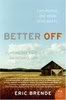
I wanted to blog about this book before I sent it off to the library. I am still thinking about the book, and haven't yet decided if or where I agree or disagree with the author's thesis. I am still in "receiving mode".
Overall, though, it was a worthwhile book to read -- reminded me a bit of Crunchy Cons, for some reason. Both young, basically urban and highly educated Catholics, who are trying to reclaim (in different ways) some kind of more organic, traditional rhythm of life, more related to the sacramentality of the nature of the material world.
This quote was interesting because he is talking about a book called The Education of Henry Adams -- as he says "it broached the subject of technological infatuation in our nation's past". He particularly refers to the chapter on The Dynamo and the Virgin -- which is interesting because I first read about this dichotomy in John Senior's book Restoration of Christian Culture. This is where I, personally, give a major hat tip to technology in the form of Google, because when I looked it up, I found an interview with Eric Brende (author of Better Off) where he explicitly acknowledges an intellectual and spiritual debt to John Senior:
I had a tremendous intellectual conversion experience when I took a couple of years off and studied at the Integrated Humanities Program at University of Kansas—which has since been dismantled, tragically. It was led by the famous professor John Senior—who served as my sponsor when I became a Catholic. He provided insights into the pitfalls of the machine society which had never dawned on me before. Most centrally, realization that if machines do everything for us, then what's left for us to do? What meaning do we have left? If we have machines to live life for us, then we don't have to live. Life eventually seems not worth the trouble of living. Have a machine do it—or spend life skimming off the frosting of experience, without including any of the substance. The social problems, the plague of depression, social disarray in our society—it's all related directly or indirectly to this takeover by technology. Ironically, our lives become less convenient as a result of our conveniences, since we're always trying to recover what technology took away from us.Oh dear! I've written all this and not gotten to the quote yet. Brende writes about how the book had "long daunted me....."
The autobiography of John QUincy Adam's grandson and a man of letters, it had set the tone for a whole era of Americans.... and I had never been able to get past the first two pages.
Tonight, to the flicker of a kerosene lamp, I made inexplicable, rapid progress. When I got to the twenty-fifth chapter, "The Dynamo and the Virgin," I found Adams falling prostrate before the dynamo at the Great Exposition held in Paris in 1900, a huge electric generaator with a giant cranking arm. To him the slowly undulating device symbolized a new and unprecedented Force that supplanted once and for all the animate energies of nature. A narrow and inhuman power at last had vanquished Fecundity, or Reproduction, which Adams personified in the Virgin and portrayed as the source of natural bounty. But even as he wrote wistfully about her passing, he bowed before what had replaced her.
Adam's poignant shift in allegiances haunted me.....
Here are Adams' words, which John Senior quotes in his book:
Then he showed his scholar the great hall of dynamos, and explained how little he knew about electricity or force of any kind, even of his own special sun, which spouted heat in inconceivable volume, but which, as far as he knew, might spout less or more, at any time, for all the certainty he felt in it. To him, the dynamo itself was but an ingenious channel for conveying somewhere the heat latent in a few tons of poor coal hidden in a dirty engine-house carefully kept out of sight; but to Adams the dynamo became a symbol of infinity. As he grew accustomed to the great gallery of machines, he began to feel the forty-foot dynamos as a moral force, much as the early Christians felt the Cross. The planet itself seemed less impressive, in its old-fashioned, deliberate, annual or daily revolution, than this huge wheel, revolving within arm's length at some vertiginous speed, and barely murmuring -- scarcely humming an audible warning to stand a hair's-breadth further for respect of power -- while it would not wake the baby lying close against its frame. Before the end, one began to pray to it; inherited instinct taught the natural expression of man before silent and infinite force. Among the thousand symbols of ultimate energy the dynamo was not so human as some, but it was the most expressive.
Subscribe to:
Posts (Atom)